
- Posted on
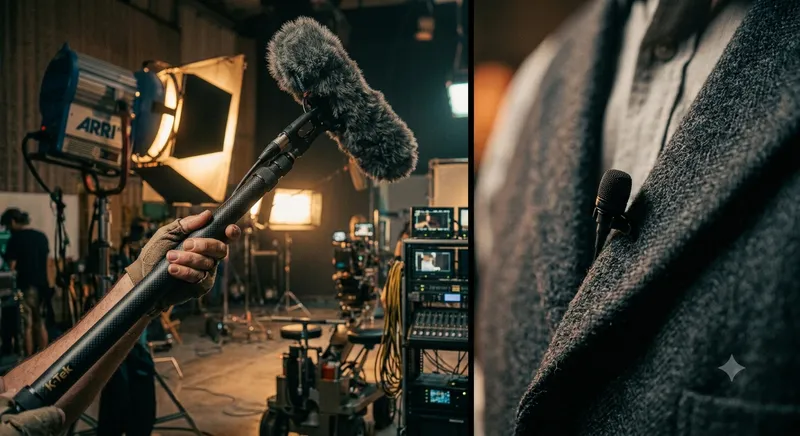
Module 1: The Great Debate—Boom vs. Lavalier
In a perfect world, every dialogue track would be captured with crystal clarity by a microphone positioned six inches from the actor’s mouth, without any visible equipment or electronic interference. In reality, location sound is rarely about perfection; it is often an exercise in choosing which compromise you are willing to live with for the duration of a scene.
The Shotgun Boom: Pursuring Naturalism
The boom pole remains the gold standard for dialogue capture because it respects the physics of how humans experience sound. When we use high-quality shotgun microphones suspended just above and out of frame, we capture audio that feels "anchored" in its physical environment rather than inside a listener's head or muffled by clothing fibers.
- Goal: To achieve maximum fidelity with minimum acoustic coloring—capturing the voice as it interacts naturally with the space around the actor.
- Challenge (Proximity vs. Shadow): To get great sound, you need to be close. However, two primary obstacles arise. First is proximity effect, where moving a directional mic too close to a source causes an exaggerated boost in low-frequency response, making voices sound "boomy" and unnatural. Second—and more critical for production logistics—is the issue of visibility. A boom pole casting a shadow across an actor’s face or entering the edge of a lens can ruin minutes of expensive lighting setups and cinematography work.
- Pro Strategy: Never operate in a vacuum. The most successful mixers maintain constant communication with the camera department to understand "lens height" and field-of-view limits. Knowing exactly where your frame ends is just as important as knowing how long your microphone cable is. A great mixer anticipates when they are about to hit their limit before it becomes a visual problem for the DP (Director of Photography).
The Lavalier: Mastering Mobility and Reliability
When scenes break into high action—a chase through an alleyway, or two characters walking rapidly down a busy street—the boom pole ceases to be viable. It cannot follow rapid lateral movement without being seen by moving cameras on gimbals or dollies. This is where lavaliers (wireless lapel microphones) become your lifeline.
- Goal: To provide consistent dialogue coverage regardless of actor mobility and camera angle changes.
- Challenge (Rustle and Radio): Laveliers are notoriously temperamental. They suffer from "handling noise"—the rhythmic, low-frequency swish-swish caused by the microphone capsule rubbing against fabric. Furthermore, in a modern production set teeming with wireless video transmitters, walkie-talkies, and hundreds of cell phones, managing RF (Radio Frequency) interference is an Olympic sport.
- Pro Strategy: Treat lavaliers as your "safety net." Even when using the boom for primary dialogue, having a well-placed lapel ensures that if an actor turns their back to the camera or moves out of range unexpectedly, you haven't lost the entire take. A professional mixer uses the bom is the art, but the lavalier provides the insurance.
👉 Return to RR.COM 👈