
- Posted on
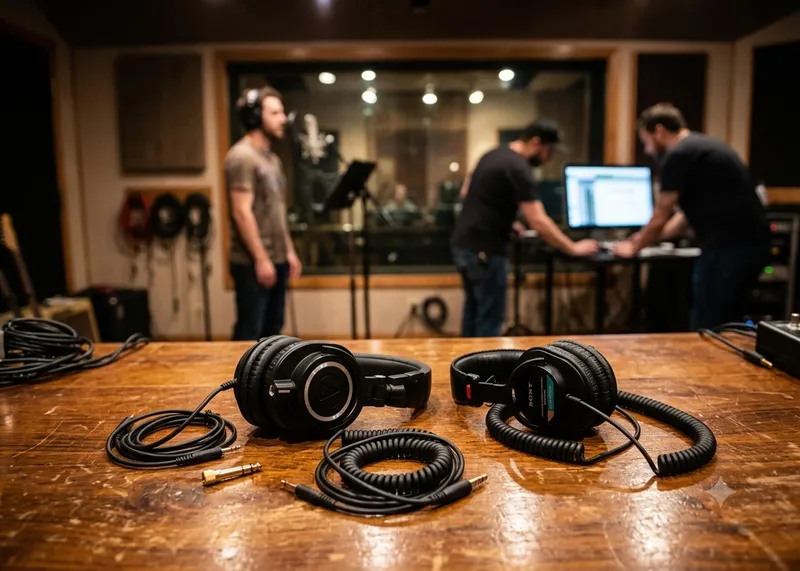
Studio Standard vs. Modern Workhorse: Choosing Your Field Recording Headphones
For professional field recording, your choice of headphones is critical. You need gear that is reliable, provides an accurate representation of your audio, and offers sufficient isolation from the environment.
The Sony MDR-7506 and the Audio-Technica ATH-M50x are two of the most popular studio monitors, but they serve slightly different purposes in the field.
At a Glance: Comparison Table
| Feature | Sony MDR-7506 | Audio-Technica ATH-M50x |
|---|---|---|
| Best For | Critical monitoring & accuracy | Monitoring & versatile use |
| Sound Profile | Bright, analytical, "standard" | Boosted bass/treble, "fun" |
| Durability | Proven, but plastic-heavy | Robust "tank-like" construction |
| Cable | Non-detachable, long coil | Detachable (3 options included) |
| Comfort | Lightweight, high clamping force | Moderate weight, snug fit |
| Portability | Folds compact | Folds & swivels |
Deep Dive: Professional Field Recording
The Case for the Sony MDR-7506
The MDR-7506 has been an industry standard for decades. If you walk onto a film set or a professional broadcast interview, you are almost guaranteed to see these around someone's neck. (Charles Cleyn)
- Pros:
- Analytical Clarity: They are known for a "brighter" sound that highlights mid-to-high frequencies. In field recording, this makes it easier to spot background noise, handling noise, or vocal sibilance that you might otherwise miss.
- Industry "Language": Because so many professionals use them, you gain a common frame of reference. If a sound sounds "off" on a 7506, other engineers likely hear the same thing.
- Portability: They fold up very compactly and are lightweight, which is a major bonus when hiking or moving through tight shooting spaces. (PetaPixel)
- Cons::
- The Cable: The cable is fixed. If it snaps or frays, you have to solder a replacement yourself or pay for a repair.
- Fatigue: The high-frequency emphasis can lead to "ear fatigue" during very long recording days. (Home Studio Basics)
The Case for the Audio-Technica ATH-M50x The M50x is a more modern, consumer-friendly evolution. It is arguably more versatile if you are doing a mix of field recording, editing, and casual listening.
- Pros:
- Detachable Cables: This is the biggest advantage for field work. It comes with multiple cable options (coiled, short, long), making it easy to adapt to your recorder without having yards of excess cable snagging on gear.
- Sturdy Build: They are physically robust. They handle the "toss it in the bag" abuse of field production quite well.
- Low-End Presence: If you are recording ambience or sound effects with deep sub-bass frequencies, the M50x provides a more powerful bass response that can help you gauge the "weight" of a recording better.
- Cons::
- Sound Coloration: The "V-shaped" sound (boosted bass and treble) can sometimes mask issues in the midrange where critical dialogue or subject matter lives.
- Clamping Force: Some users find the clamping force a bit intense during the first few weeks of use, which can become uncomfortable over an 8-hour shift.
The Verdict for Field Work
Choose the Sony MDR-7506 if: You are primarily recording dialogue, interviews, or location sound where hearing subtle, high-frequency details (like unwanted background buzz or mouth clicks) is your top priority. Their "analytical" sound is a tool that keeps you honest about your signal.
Choose the Audio-Technica ATH-M50x if: You need a "do-it-all" headphone. If your workflow involves recording in the field and then immediately sitting down at a laptop to edit, or if you need a headphone that you can also enjoy for music production and casual use, the M50x is more versatile.
Pro-Tip for Field Recordists: No matter which pair you choose, invest in high-quality third-party earpads (like velour or memory foam replacements). Stock leatherette pads can get sweaty and uncomfortable in hot field conditions, and upgrading them is a common practice among pros to extend both comfort and the lifespan of the headphones.
👉 Return to RR.COM 👈