
- Posted on
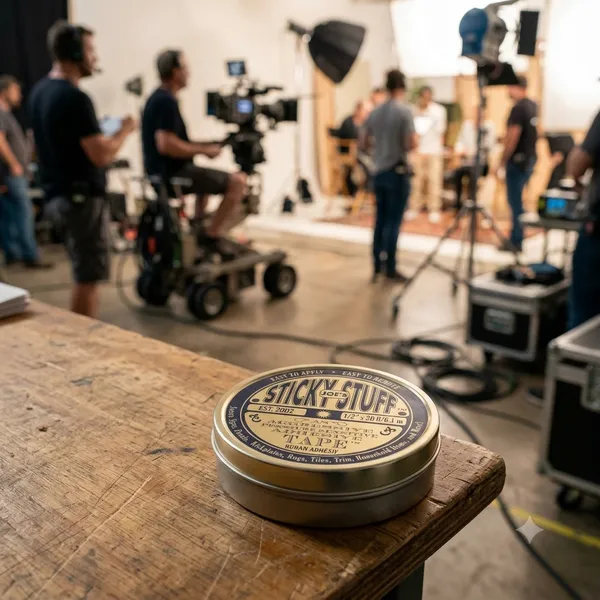
The Set Essential: When and Where to Reach for Joe’s Sticky Stuff
If you’ve ever spent time on a film set, you’ve probably heard someone yell for "snot tape." More often than not, they’re looking for a roll of Joe’s Sticky Stuff.
Invented by Hollywood prop master Joe Connolly, this aggressive, clear, double-sided pressure-sensitive adhesive has become an absolute industry standard. But because it grips like crazy yet peels away cleanly, knowing exactly when and where to deploy it can save your track, your set, or your sanity.
When to Use It: The Ideal Scenarios Joe's Sticky Stuff is a problem-solver for temporary but heavy-duty mounting. You should reach for it when:
- Residue is a Dealbreaker: Unlike standard carpet tape or heavy-duty gaffer tape, it leaves zero gummy residue and won't mar delicate finishes or strip the paint off a location's walls.
- You Need Vibration Dampening: Because it’s a pliable, rubber-like butyl material, it absorbs micro-vibrations—making it a secret weapon for audio capture.
- An Object Needs to Look "Un-Taped": Since it’s double-sided and hides completely beneath an object, it’s perfect for anything that will be seen on camera or on display.
Where It Shines: Department by Department While the art department might run through the most rolls, this stuff is universally loved across the entire crew.
1. In the Sound Department: Taming Lavaliers Hiding a lav mic under stiff clothing or on a tricky chest piece? A tiny piece of Joe's Sticky Stuff can lock down a capsule, stick a mic mount directly to skin or fabric, and instantly kill clothing rustle by immobilizing the fabric layers.
2. In the Prop & Set Dec Departments: Locking It Down Whether it's keeping a picture frame perfectly level on a wall, securing a rogue rug from sliding during a high-energy stunt, or keeping props perfectly static on a shelf between takes, this tape keeps everything exactly where the continuity log says it should be.
3. On the Camera Rig: Quick Tools Need your dry-erase markers right next to the slate? Want to temporarily mount a small wireless receiver or a reference card to a monitor cage? A little piece of Sticky Stuff gives you an instant mounting point without adding bulk.
4. Off-Set & Around the House The utility doesn’t stop when production wraps. It's the ultimate tool for running desk cables cleanly along a wall, anchoring drawer organizers so they don't slide around, or hanging temporary seasonal decorations without putting holes in the drywall.
Pro Tip for Clean Removal: Don't just yank the object straight off. Give it a gentle twist to break the initial seal, then slowly stretch and peel the tape away from one end. It will lift off in one clean piece.
How does Joe's Sticky Stuff perform in extreme weather conditions like high heat or freezing cold, and how should you handle it?
Like most pressure-sensitive adhesives, Joe’s Sticky Stuff is highly responsive to the environment. Because it is a pliable butyl-based gel, temperature shifts alter its physical properties—making it behave very differently on a freezing exterior night shoot versus a scorching blacktop in mid-July.
Here is how it performs under extreme conditions and exactly how to handle it.
🥶 In Freezing Cold: The "Glass" Effect When the temperature drops (especially below 40°F / 4°C), the liquid components within the adhesive begin to harden.
The Performance: The tape loses its "wetting ability" (its power to flow into the microscopic pores of a surface). It becomes stiff, dry, and brittle. If you try to apply it cold, it simply won't grab, or it will pop right off under the slightest weight.
The Fix: *Warm the tape: Keep the roll or tin of Sticky Stuff inside your inner jacket pocket close to your body heat until the moment you need it ***Prep the surface**: If you are sticking it to a cold piece of metal or plastic, quickly warm the area with a pocket heater, hair dryer, or even your hands before applying the tape. Once it bonds at a warm temperature, it handles the cold much better.
🥵 In High Heat: The "Meltdown" Effect On the flip side, extreme heat (above 90°F / 32°C) softens the tape's internal structure.
*The Performance: The adhesive shifts from being firm and elastic to overly soft and gooey. While its initial tack (stickiness) will actually increase, its cohesive strength drops. Under heavy loads or vertical stress (like a heavy prop hanging on a wall in a hot warehouse), the tape can stretch out like warm taffy, causing the object to sag or fall. (Lamtek)
The Fix: *Keep it cool: Store your rolls in a shady spot, an air-conditioned production vehicle, or a cool gear case—never leave the tin sitting face-up on a hot gear cart in direct sunlight. Increase surface area: If you must use it in hot conditions, use a slightly larger piece than normal to distribute the weight and prevent the softened gel from shearing or slipping.
🌡️ The Golden Rule for Storage and Application
Acclimatize Before You Apply: For the absolute strongest bond, always apply Joe's Sticky Stuff at a comfortable room temperature (60°F to 85°F). Once the tape has had a few minutes to fully "wet out" and bond to a clean surface, it can successfully withstand significant temperature drops or shifts afterward.
How do you clean up or remove residue from butyl adhesives like Joe's Sticky Stuff if they melt or smear?
Because butyl is a synthetic rubber and not a traditional water-based glue, reaching for standard soap and water will only smear it around. You need a specific approach to break it down without damaging the surface underneath.
The Best Methods for Cleanup
1. The "Fight Fire with Fire" Method (Mechanical Removal) Before applying any liquids, use the adhesive's own cohesive nature to lift the residue.
- Take a fresh, clean piece of Joe's Sticky Stuff (keep it cool so it’s firm).
- Press it firmly directly onto the smeared residue, then yank it away quickly.
- The residue will often prefer to stick to the fresh piece of tape rather than the surface, pulling it up cleanly without chemicals.
2. Citrus-Based Cleaners (Best Overall) If the smear is too flat or thin to lift mechanically, a citrus-based adhesive remover is your absolute best option.
- Products: Goo Gone or commercial-grade D-Limonene cleaners.
- How it works: The natural oils in citrus break down the butyl polymer chains, turning the sticky gel into a non-tacky liquid.
- Process: Apply a small amount to a clean microfiber cloth, let it sit on the smear for 60 seconds, and wipe it away. Wipe the area with a damp cloth afterward to remove the oily cleaner.
3. Isopropyl Alcohol (Safe for Electronics and Sound Gear) If you are cleaning a lav mic capsule, wireless transmitter, or sensitive camera rig, avoid oily citrus cleaners.
- Use 91% or 99% Isopropyl Alcohol (IPA).
- Apply it to a cotton swab or microfiber cloth. It won't dissolve the butyl as quickly as citrus, but it will rapidly dry out the tackiness, allowing you to roll the residue off into small balls with your finger or a cloth.
🚫 What to Avoid
- WD-40: While it will dissolve butyl rubber, it leaves behind a heavy petroleum film that is incredibly difficult to completely clean off, which might ruin the surface for future tape applications.
- Acetone or Nail Polish Remover: Do not use this on plastics, painted surfaces, or gear chassis. Acetone will easily melt plastic housing, strip paint, and ruin delicate finishes.
- Tissues or Paper Towels: Never rub a wet smear with cheap paper towels or tissues. The loose fibers will instantly bond to the butyl, creating a fuzzy, cemented mess that is twice as hard to clean. Stick to microfiber cloths or specialized non-woven wipes.
- ALWAYS TEST ANY SOLVENTS OR CHEMICALS IN AN INCONSPICUOUS LOCATION!
Sound & Camera Crew Tip: If you're working with delicate lavalier mic cables or clothing fabrics, always test a tiny drop of your cleaner on an inconspicuous spot first to ensure it won't discolor the material or degrade the rubber coating of the wire.
Life is better when we all stick together!