
- Posted on
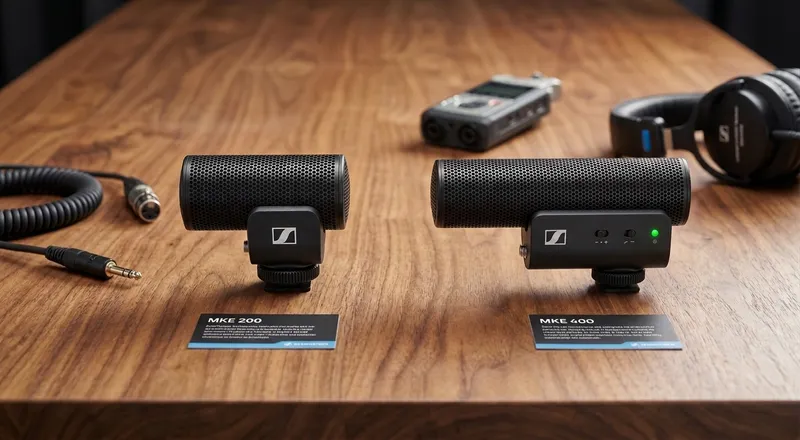
Sennheiser MKE 200 vs. MKE 400: Which Compact Shotgun Mic is Right for Your Content Creation?
In the age of social media and mobile filmmaking, video quality alone isn't enough—crisp, professional audio is what truly engages an audience. Sennheiser has addressed this need with two of their most popular compact shotgun microphones: the MKE 200 and the MKE 400. Both are designed to drastically outperform internal camera mics, but they cater to slightly different workflows. Let’s break down how they compare in design, sound, features, and target audience.
📐 Technical Specifications & Build
Both mics are built for on-the-go creators, but they approach portability and technical construction differently.
The MKE 200 is an ultra-compact directional microphone featuring a supercardioid pickup pattern [5]. Its mostly metal body feels solid, durable, and lightweight enough to sit comfortably on mirrorless cameras or gimbals without throwing off the balance [4]. It measures roughly 4.7" × 1.5" and weighs around 60g.
The MKE 400 also uses a supercardioid transducer but is housed in a shorter, plastic construction designed to keep weight down when mounted to a camera or smartphone [3]. While its build doesn't feel as reassuringly solid as the MKE 200, it is functional, handsome, and measures roughly 4.3" × 1.3" [3]. Despite the plastic housing, it carries a slightly higher weight of ~75g due to its internal battery compartment and active electronics.
🔋 Power & Connectivity
How you power and connect your mic often dictates your on-set workflow.
- MKE 200: This mic relies entirely on plug-in power drawn directly from your camera or recorder [4]. There are no internal batteries to manage, charge, or replace. It connects via a standard 3.5mm TRS/TRRS mini-jack [5].
- MKE 400: In contrast, the MKE 400 is powered by two AAA batteries, which Sennheiser claims will last up to 100 hours [3]. The mic automatically turns on upon connection to prevent accidental battery drain [3]. It ships with both TRS and TRRS minijack leads, but notably features a locking 3.5mm connector that prevents accidental disconnections during active shooting [6].
🎙️ Sound Quality & Controls
Both microphones prioritize dialogue, but their sonic profiles and control options differ significantly.
The MKE 200 delivers crisp, midrange-focused sound that significantly improves speech intelligibility and reduces room noise compared to built-in camera mics [4]. It offers healthy headroom for louder speakers, but when compared side-by-side with the 400, it can sound comparatively “gained-up” with less overall headroom [3]. Because it completely lacks onboard gain or low-cut switches, users with cameras featuring weaker preamps may need to boost the camera’s gain, which can slightly raise the noise floor for quiet speakers [4].
The MKE 400 steps up the audio game with impressive speech clarity, particularly in the high-mids and consonant range [3]. It excels at off-axis noise rejection, effectively attenuating background traffic and environmental rumble [3]. The 400 boasts active circuitry that provides direct monitoring via a dedicated 3.5mm headphone port, digitally-controlled volume, gain adjustment options (-20dB, 0dB, +20dB), and a high-pass filter that rolls off frequencies around 200Hz to cut low-end rumble [3].
📦 What's in the Box?
- MKE 200: Comes with a foam windshield, a furry windjammer option, a shock mount, a standard 3.5mm cable, and a carrying pouch [4]. For strong outdoor winds, you will want to use the supplied furry windshield, as the base foam cover has limits [4].
- MKE 400 Mobile Kit: This package is incredibly comprehensive for mobile creators. It includes a sturdy Sennheiser smartphone clamp, a Manfrotto Pixi Mini tripod, multiple cables, and a furry windshield right out of the box [3].
💰 Price Comparison
- Sennheiser MKE 200: Approximately $150 – $180
- Sennheiser MKE 400: Approximately $200 – $250 (Standard version)
- Sennheiser MKE 400 Mobile Kit: $345 (Includes smartphone clamp, tripod, and extra cables)
Note: Prices fluctuate depending on the retailer and regional taxes.
📊 MKE 200 vs. MKE 400: Quick Comparison Table
| Feature | Sennheiser MKE 200 | Sennheiser MKE 400 |
|---|---|---|
| Approx. Price | $150 – $180 | $200 – $250 (Standard) $345 (Mobile Kit) |
| Microphone Type | Supercardioid Condenser | Supercardioid Shotgun-style Condenser |
| Power Source | Camera Plug-in Power (Passive) | 2 × AAA Batteries (~100 hrs) |
| Onboard Controls | None | Gain Switch (-20/0/+20dB), 200Hz Low-Cut Filter, Headphone Monitor |
| Connector | 3.5mm TRS/TRRS (Standard) | 3.5mm Locking TRS/TRRS |
| Dimensions | ~4.7" × 1.5" (120 × 37 mm) | ~4.3" × 1.3" (110 × 33 mm) |
| Weight | ~60 g (2.1 oz) | ~75 g (2.6 oz) |
| Included Wind Protection | Foam windscreen | Furry windshield (Mobile Kit includes extra wind protection & cables) |
| Best Suited For | Travel vloggers, hybrid shooters, DSLR/mirrorless users who want simplicity | Smartphone creators, run-and-gun filmmakers, anyone needing real-time audio monitoring & control |
🎯 Target Audience & Final Verdict
So, which one should you choose?
Choose the Sennheiser MKE 200 if: You are a vlogger, travel shooter, or hybrid creator who prioritizes absolute simplicity and minimal setup time. If you want a lightweight, durable audio upgrade that requires zero batteries or menu diving, the MKE 200 is a pragmatic, reliable companion for run-and-gun shoots [4].
Choose the Sennheiser MKE 400 if: You are a mobile content creator, smartphone videographer, or solo musician who needs straight-to-phone audio that is ready to share. The added onboard controls, superior speech clarity, high-pass filter, and the fact that it ships with a tripod and clamp make the MKE 400 a true sonic contender for creators who shoot basic video content or conduct livestreams [3].
The Bottom Line: Both mics are fantastic upgrades over internal camera audio. If you value bulletproof simplicity and a metal build, the MKE 200 wins. But if you want professional-level audio control, better noise rejection, and a complete out-of-the-box kit for mobile filming, the MKE 400 is the superior choice.
🔗 Source & Reference Links
- View Sennheiser MKE 200 at B&H Photo Video
- View Sennheiser MKE 400 at B&H Photo Video
- Read AudioTechnology Review of the MKE 400
- Read LensesPro Review of the MKE 200
- View Sennheiser MKE 200 at Adorama
- View Sennheiser MKE 400 at Adorama
👉 Home 👈