- Posted on
What’s New in Location Audio for Q3 2026: The Gear, Upgrades, and Workflows Shaping Sound for Picture
If you’ve been out in the field this season, you know that the location audio landscape is shifting faster than ever. As production setups grow leaner and timecode/wireless environments become more complex, manufacturers are responding with wider tuning bandwidths, ruggedized chassis, and integrated IP networking.
The third quarter of 2026 brought a surge of announcements and official rollouts—headlined by major trade shows like IBC 2026 in Amsterdam. Whether you run a full sound cart or pack a compact bag setup for documentary run-and-gun operations, here is a detailed breakdown of the newest products, updates, and innovations available to location sound professionals this quarter.
1. Wireless Systems & Transmitters
Sound Devices Astral Mini Plus
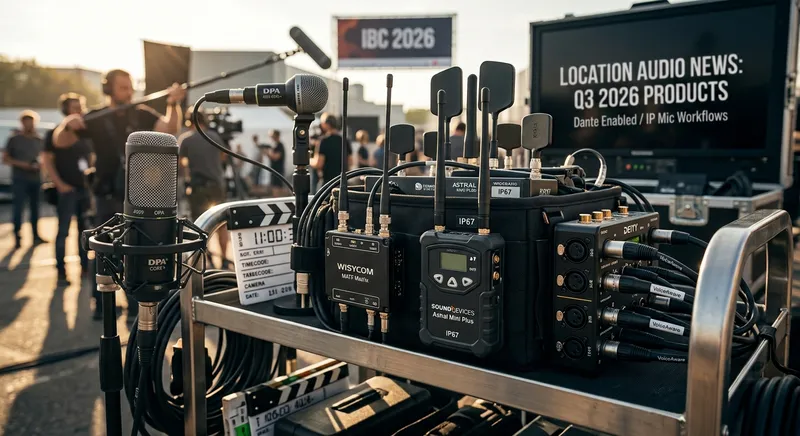
Sound Devices expanded its flagship Astral wireless ecosystem with the launch of the Astral Mini Plus bodypack transmitter. Built for high-demand narrative sets and live broadcast environments, the Mini Plus upgrades battery performance while keeping a ultra-compact footprint.
- Key Features:
- Ultra-wide Tuning Range: Covers 169 MHz to 1525 MHz in a single unit, drastically simplifying international touring and multi-region shoots.
- IP67 Water Resistance: Fully sealed housing designed to handle harsh outdoor elements.
- Battery Life: Delivers over 8 hours of continuous run-time on a single charge.
Workflow Integration: Full remote control and monitoring via Sound Devices' wireless control suite.
Learn More: Sound Devices Official Announcement
Wisycom MATF Wideband Matrix & PFL Portable IFB Upgrades
At IBC 2026, Wisycom highlighted major advancements in RF distribution and talent/client monitoring.
- MATF Wideband Antenna Matrix: Designed for large multi-zone setups (reality TV, multi-stage events, wide-area film sets), allowing sound recordists to route and mix RF signals seamlessly across multiple antenna inputs.
- PFL Portable Receiver (IP65 Rated): Updated for rugged outdoor workflows. Features a new three-channel IFB mode alongside wideband and narrowband operation, plus built-in support for ENR and ENC companders for backward compatibility with legacy Wisycom hardware.
- Learn More: Wisycom IBC 2026 Updates on The Broadcast Bridge
2. Recorders, Field Mixers & Bag Gear
Deity Microphones PR-4 Compact Field Recorder
Deity Microphones expanded into dedicated field recording hardware with the Deity PR-4, a budget-conscious, feature-rich 6-track recorder aimed at ENG operators, documentarians, and small crews.
- Ergonomic Layout: XLR inputs are situated on the right ("dumb") side of the unit, while line/camera outputs sit on the left, keeping cable runs to the camera body extremely neat.
- Advanced I/O & DSP: Supports four channels of AES3, digital AES42 microphones, and features built-in VoiceAware Automix for real-time stereo reference mixes.
- Control: Wirelessly managed via the Sidus Audio app for easy parameter adjustments from a phone or tablet.
- Learn More: Deity PR-4 Announcement on Mixonline
3. Microphones & Networked Audio (AoIP)
The Rise of IP-Enabled Microphones in the Field
One of the biggest technological shifts reaching maturity in late 2026 is the adoption of IP-enabled microphones and Dante endpoints for location work.
Instead of converting micro-volt level microphone signals over long analog copper runs, manufacturers are embedding preamps, A/D conversion, and DSP directly inside the microphone capsule housing or local stage boxes. Power over Ethernet (PoE) allows a single Cat5e/Cat6 cable to handle multi-channel digital audio transmission and power, reducing rig weight on large-scale field broadcasts, sports productions, and reality sets.
DPA 4099 CORE+ Microphone Series
For recordists capturing live acoustic instruments or specialty source audio for film score production and ambient sound design, DPA refreshed its flagship clip-on line with the 4099 CORE+.
- Upgraded mounting clip ergonomics for faster placement on set.
- Refined capsule tuning for lower distortion at extreme SPLs and better off-axis rejection.
- Learn More: DPA Microphones Press Release
Summary Table: Quick Comparison
| Product | Brand | Primary Use Case | Standout Feature |
|---|---|---|---|
| Astral Mini Plus | Sound Devices | Wireless Bodypack Transmitter | 169–1525 MHz tuning range, IP67 waterproof |
| PFL Receiver (3-Ch) | Wisycom | Talent & Director IFB / Monitoring | IP65 rated, 3-channel IFB mode with legacy compander support |
| MATF Matrix | Wisycom | RF Distribution & Antenna Switching | Wideband multi-zone antenna switching |
| PR-4 Field Recorder | Deity | Bag / Camera-Mounted 6-Track | AES3/AES42 support, camera-friendly I/O layout, Sidus app integration |
| 4099 CORE+ | DPA Microphones | Specialty Source & Instrument Capture | Low distortion at high SPL, refined mounting clip system |
What Gear Are You Adding to Your Kit?
From wideband RF flexibility to low-profile field recording, Q3 2026 has shown that manufacturers are prioritizing durability, remote control, and bandwidth efficiency.
Are you updating your bag rig this season or taking the jump into Dante/AoIP field setups? Let us know in the comments below!
References & Links
- Mixonline / Sound Devices Astral Mini Plus & IBC 2026 Updates: Sound Devices Showcase at IBC 2026
- The Broadcast Bridge / Wisycom IBC Releases: Wisycom Showcases Latest Innovations At IBC 2026
- Mixonline / Deity PR-4 Release: Deity Debuts PR-4 Compact Field Recorder
- Dale Pro Audio / IP Microphones Tech Corner: Why IP-Enabled Microphones are Taking Off in Professional Broadcast
- DPA Microphones Press Room: DPA Showcases 4099 CORE+ at NAMM & Industry Expos