
Inside Audio

THEOS

All posts tagged THEOS by Inside Audio
  • Posted on
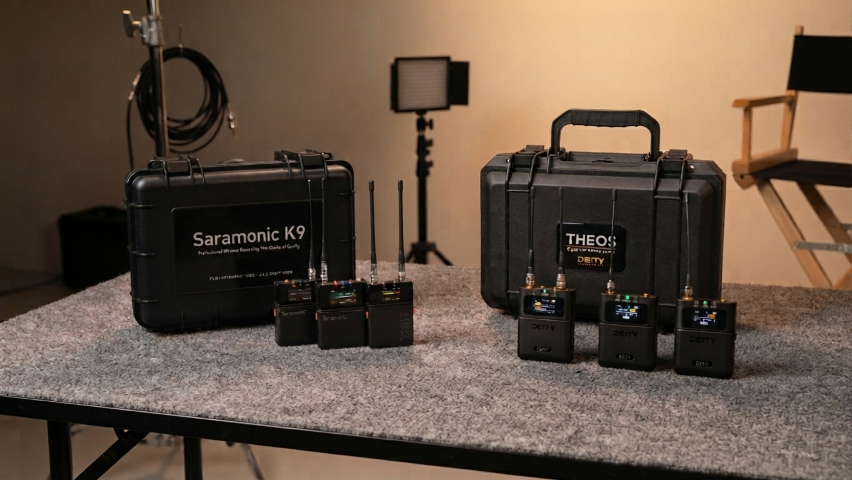
    Wireless Showdown: Saramonic K9-US vs. Deity Theos

    Wireless Showdown: Saramonic K9-US vs. Deity Theos

    In the world of professional audio, the jump from 2.4GHz wireless systems to dedicated UHF spectrums is a game-changer. Two of the most talked-about contenders in this space are the Saramonic K9-US and the Deity Theos.

    Both systems are designed to deliver reliable, interference-free audio for high-level content creators, documentary filmmakers, and production professionals. But which one belongs in your gear bag? Let’s break down how they compare.

    At a Glance: Key Similarities

    • Spectrum: Both move away from the congested 2.4GHz band, utilizing wideband UHF for more stable performance in complex RF environments. (NewsShooter)

    • Build Quality: Both feature rugged, professional-grade construction (aluminum housings) designed for daily field use. (Deity Microphones)

    • Pro Features: Both include backup microSD recording (with 32-bit float support), timecode compatibility, and mobile app control for remote management. (Fstoppers)

    • Power: Both offer flexible powering options, including USB-C for external power packs, ensuring you won't run dry during a long shoot. (FilmTools)

    Where They Differ

    Feature Saramonic K9-US Deity Theos
    Diversity Non-diversity receiver Antenna diversity (reduces dropouts)
    Control Top-mounted display for bag-viewing Full-color LCD screen
    Ecosystem Standalone powerhouse Deep integration with Deity TC-1 timecode gear
    Form Factor Optimized for fast mobile setups Optimized for traditional audio bags
    Antenna Design Fixed/Elbow-style; SMA connection for external paddles Detachable SMA antennas

    The Deep Dive

    Saramonic K9-US: The Versatile Speedster

    The K9-US feels purpose-built for the "run-and-gun" shooter who needs to transition between cameras, mixers, and mobile devices effortlessly. Its standout feature is the dual-display system—having a screen on top of the receiver is a massive benefit if you are working out of an audio bag and need a quick status check without pulling the unit out. Its USB-C digital output also makes it incredibly friendly for direct-to-phone recording.

    Deity Theos: The Workflow Specialist

    The Theos system shines in more controlled, professional environments. The inclusion of antenna diversity is a significant technical advantage, providing a much higher safety net against signal dropouts in challenging locations. Furthermore, if you are already invested in the Deity ecosystem (or rely heavily on timecode workflows), the Theos integrates seamlessly with the TC-1 generators, making sync-heavy productions significantly easier to manage.

    Which One Should You Choose?

    Choose the Saramonic K9-US if:

    • You prioritize agility: You frequently switch between cameras, smartphones, and computers.

    • You work in bags: The top-mounted screen is a lifesaver for audio professionals monitoring levels in a mixer bag.

    • You want a "plug-and-play" professional kit: It feels slightly more geared toward the solo operator who needs a reliable, all-in-one setup right out of the box.

    Choose the Deity Theos if:

    • Signal stability is your #1 priority: The antenna diversity gives it an edge in tough RF environments.

    • You are a timecode pro: If your workflow revolves around multi-cam setups and timecode-synced audio, the Theos ecosystem is hard to beat.

    • You want modularity: Being able to swap or upgrade antennas for specific distance or environment needs offers more long-term flexibility.

    Final Note: Always verify your local regional frequency regulations before operating any UHF equipment, as both systems utilize wide frequency ranges to ensure global compliance.

    👉 Return to RR.COM 👈
  • Posted on
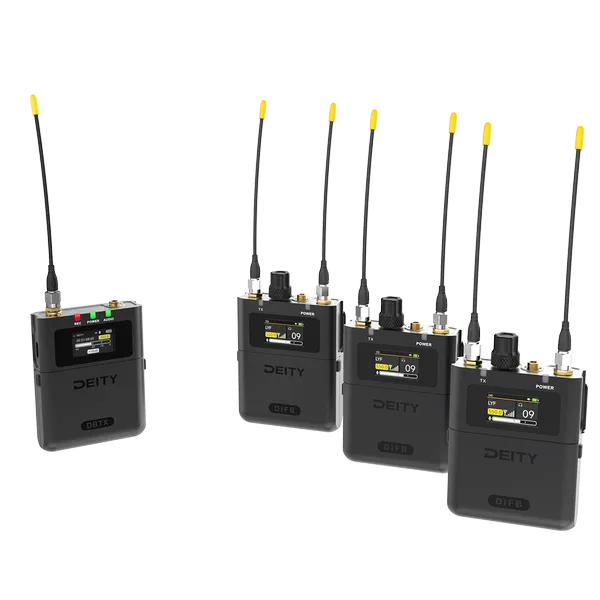
    Deity THEOS DIFB, a Game-Changer

    Sound on Set: Why the Deity THEOS DIFB is a Game-Changer for Wireless Monitoring

    If you’ve ever worked on a chaotic film set, you already know that IFB (Interruptible Foldback) systems are the unsung heroes of production. Keeping the director, script supervisor, and clients tuned into clean, real-time dialogue isn’t just a luxury—it’s vital for a smooth workflow.

    For years, location sound mixers have had to choose between clunky legacy systems or expensive, high-end monitoring setups. Enter the Deity THEOS DIFB (and its North American counterpart, the HUSH Wireless). Deity has completely shaken up the monitoring game by bringing ultra-wideband digital tech and massive quality-of-life updates to the crew's ears.

    Let’s dive into why this system is quickly becoming a staple in location sound bags.

    1. Global OneBand™ Tech: Total Frequency Freedom

    Navigating local RF laws can be a nightmare, especially for traveling filmmakers. The THEOS DIFB introduces an incredibly wide tunable range of 550MHz to 960MHz.

    The Smart Feature: By syncing with your phone’s GPS via the Sidus Audio app, the DIFB automatically conforms to the local RF regulations of whatever country you just landed in. No more accidental fine-inducing transmissions.

    2. Built for the Reality of Production

    Older IFB receivers often feel like cheap plastic walkie-talkies. Deity built the DIFB with a rugged, full-metal housing meant to survive the inevitable drops and bumps on set.

    But what really sets it apart mechanically is how it handles the user experience:

    • True Diversity Monitoring: Dual SMA ports and dual antennas mean fewer dropouts when a producer wanders behind a grip truck.

    • Top-Facing Metal Volume Knob: Sound mixers rejoice! Your clients no longer have to open a plastic flap just to adjust their volume.

    • Text-to-Speech (TTS) Notifications: Because these units are usually clipped to a belt or shoved in a pocket, the DIFB will literally read out the transmitter's name into the user's headphones when they switch channels. They always know exactly who they are listening to without looking at the screen.

    3. Battery Life That Outlasts the Shoot

    There is nothing more frustrating than a producer tapping you on the shoulder halfway through a day because their monitoring just died. Deity has optimized the power draw on these units significantly:

    Battery Type Expected Lifespan
    AA Up to 15–17 Hours
    -- --
    Alkaline AA Up to 10 Hours
    -- --
    1900mAh NiMH Up to 9 Hours

    Note: The system also includes an ECO Mode to dim the screen and a USB-C port for external power if you're running a permanent video village setup.

    4. Ecosystem Integration and the Sidus Audio App

    The DIFB is built to seamlessly listen in on any Deity THEOS DBTX transmitter. Using the Sidus Audio App, you can manage frequency coordination, perform bulk updates, and handle automatic frequency scans across dozens of units simultaneously.

    The receiver features a 20-frequency bank library, meaning a user can quickly rotate the metal encoder to flip between different sound bags, a director’s mix, or individual talent mics seamlessly.

    The Verdict

    The Deity THEOS DIFB bridges the gap between ultra-expensive rental house gear and budget-tier wireless kits. At roughly $299 USD for a single receiver (or around $1,096 for a 3-pack kit with a transmitter), it offers unmatched flexibility, incredible battery longevity, and rugged build quality.

    If you are looking to upgrade your wireless monitoring workflow, keep your clients happy, and stop stressing about international RF coordination, the DIFB deserves a permanent spot in your audio kit.

    Have you had a chance to deploy the Deity DIFB on your latest shoot? Let us know your thoughts on the Text-to-Speech channel naming in the comments below!