Inside Audio

Accessories

Bits & bobs for professional audio

  • Posted on
    The Unsung Hero of the Gear Bag

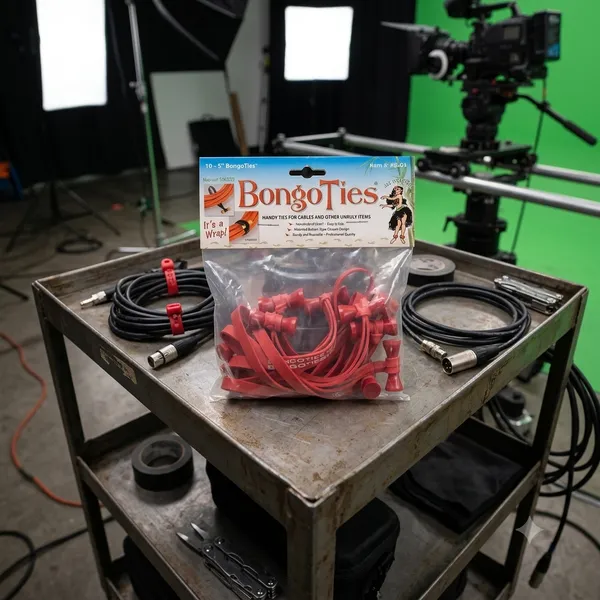
    The Unsung Hero of the Gear Bag: Why You Need Bongo Ties

    If you work in film, photography, music, or IT, you already know the nightmare: a tangled bird's nest of extension cords, HDMI leads, and audio cables sitting at the bottom of your bag.

    While the world tries to sell us complex plastic clips and disposable zip ties, the film industry's best kept secret is beautifully simple, incredibly cheap and practically indestructible.

    Meet the Bongo Tie

    Brilliant design in its simplest form.

    Invented by a pro photographer who was tired of wrestling with sticky tape and flimsy hook and loop straps, a bongo tie consists of just two elements

    1. A heavy duty, highly durable, Hevea rubber band.

    2. A patented flared bamboo pin that acts as a toggle.

    There are no gears, no hooks, no plastic to snap in cold weather. You just wrap the rubber band around your cables, loop it over the bamboo flared ends, and it snaps, locked under its own tension.

    4 reasons, they beat everything else.

    • No sticky residue: Unlike gaffer tape or electrical tape, they leave zero residue on expensive cables.
    • True one-handed operation: You can easily lock or release them with one hand while holding a heavy coil of wire with the other.
    • Reusable for years: Zip ties are a single use plastic waste nightmare. Bongo ties can be used hundreds of times before the rubber finally loses its snap.
    • The flared pin advantage: because the bamboo toggle is flared on both ends, the loop can't accidentally slide off, even under heavy vibration.

    Beyond Cables: Through Creative Uses

    While they were built for cords, anyone who owns a pack quickly discovers they are the ultimate "fix-it" tool. Production crews use them to strap wireless receivers to camera rigs, musicians use them to secure loose mic stands, and campers use them to lash gear to backpacks.

    In a world full of over-engineered gadgets, the Bongo Tie is a refreshing reminder that sometimes, the simplest solution is the best one.

    👉 Return to RR.COM 👈

  • Posted on
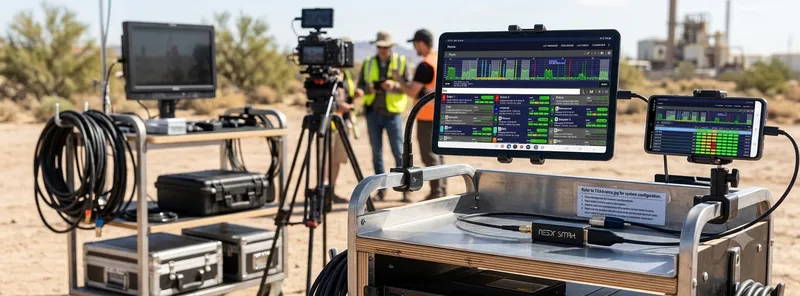
    Mastering the Airwaves: How TXAdvance Empowers Location Audio Specialists in Crowded RF Environments

    Mastering the Airwaves: How TXAdvance Empowers Location Audio Specialists in Crowded RF Environments

    For a location audio specialist, there is perhaps nothing more stressful than entering an environment—a festival groundsite, a massive convention center, or even certain urban street corners—only to find that your wireless microphone channels are being choked by interference. In today's world of ubiquitous Wi-Fi and heavy mobile data usage, RF transmissions are everywhere, making the hunt for clean frequencies one of the most challenging aspects of modern audio production.

    To ensure "clean and reliable" signals and provide peace of mind during critical recordings or live broadcasts, professionals need more than just luck; they need precision coordination. This is where TXAdvance steps in as a specialized toolkit designed to turn mobile devices into powerful RF management workstations.

    Precision Scanning: Finding the Gaps in the Noise

    The foundation of any successful wireless setup is knowing what frequencies are actually available on-site. TXAdvance leverages Software-Defined Radio (SDR) technology—utilizing common dongles like the RTL2832U, HackRF One, or Airspy Mini—to scan a massive range from 50 to 1300 MHz. For an audio professional working in high-density environments, resolution is everything. TXAdvance provides scanning with up to 5 kHz resolution, allowing you to detect subtle spikes and noise floors that might be missed by less granular equipment. This turns your tablet or mobile device into a real-time spectrum analyzer capable of detecting sporadic signal bursts before they ruin a take.

    Intelligence at Your Fingertips: Automated Coordination

    Once the scan is complete, the next hurdle for an audio specialist is frequency coordination—the mathematical puzzle of assigning frequencies to multiple transmitters without them interfering with each other.

    TXAdvance takes much of this heavy lifting out of your hands by automatically calculating intermodulation (IM) products up to the 7th order. This ensures that even as you add more channels for a large production, you aren't inadvertently creating "ghost" signals through hardware interaction. The app is designed with professional efficiency in mind:

    • Unlimited Scalability: Coordinate an unlimited number of transmitters from any manufacturer.
    • Massive Database: It comes pre-loaded with over 700 TX models and allows for custom entries, ensuring you spend less time typing and more time mixing.
    • Smart Management: Use "Auto assign frequencies" to speed up setups during the high-pressure windows of a soundcheck or live event.

    Real-Time Monitoring: Protection During Production

    The job doesn't end once your transmitters are assigned and running; that is when the real test begins. In busy environments, RF conditions can change in an instant due to new networks being activated or shifting mobile traffic. Using a loop interface (such as with an Airspy Mini), TXAdvance allows for continuous monitoring of all active transmitters. You gain access to:

    • Current and Maximum Spectrum: Visualize the signal strength across your bandwidth at any moment.
    • Noise History Tracking: Accessing the most recent 100 noise values helps you identify if a specific frequency is experiencing intermittent, "bursty" interference that might not be visible in a static scan.

    Proactive Planning with TASE (TXAdvance Scan Exchange)

    For location specialists working far from home or at unfamiliar venues, preparation begins before the gear even leaves the van. Through TASE, TXAdvance provides access to a collaborative worldwide map of geo-tagged and time-stamped RF scans.

    By downloading existing scan data for your specific destination, you can anticipate potential frequency conflicts in advance. This ability to "scout" the spectrum digitally allows you to plan your transmitter list before even arriving on site, significantly reducing setup times and risk during high-stakes location shoots.

    The Bottom Line

    In a world where airwaves are more crowded than ever, TXAdvance provides the specialized mathematical rigor and real-time visibility that modern audio professionals require. By combining precision SDR scanning with sophisticated intermodulation analysis and collaborative data sharing, it transforms mobile hardware into an indispensable tool for ensuring flawless wireless performance in any environment.

    Sorry, there is no iOS version.

    TXAdvance on Google Play Store

    👉 Return to RR.COM 👈

  • Posted on
    Beyond Ground Lifts: When Isolation Transformers are Essential

    Beyond Ground Lifts: When Isolation Transformers are Essential

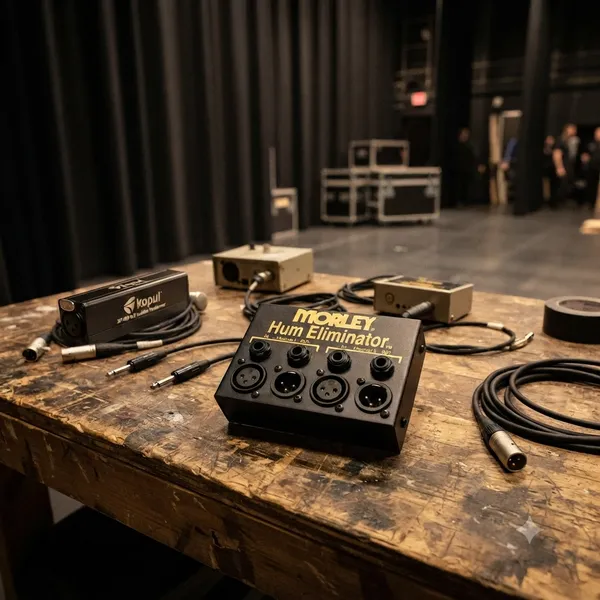
    While a ground lift switch is an excellent first line of defense for simple hum in microphone cables, it only works by breaking the electrical connection on Pin 1. This does not solve every noise problem encountered in professional environments. In many complex scenarios, you require Galvanic Isolation—a state where two circuits are completely electrically separated and communicate purely through magnetic induction via a transformer.

    Capacitive Coupling Interference This occurs when electromagnetic noise from another source "jumps" across an air gap or insulation between two conductors (like running power cables next to audio lines).
    - The Problem: A ground lift breaks physical continuity but does nothing to stop the magnetic/electrical field induction that passes through space into your cable shielding. - The Solution: An isolation transformer physically separates both signal and shield wires, using a primary and secondary winding so no electricity can actually jump between them via capacitance or proximity.

    High Potential Voltage Differentials in Large Racks
    In professional studios with multiple power circuits (e.g., one for lighting/dimmers and another for audio gear), there is often a significant "potential difference" between the electrical ground of two different pieces of equipment, even if they are both correctly grounded to their respective outlets. - The Problem: A simple switch might break your local loop, but high currents or noise can still travel through shared metal chassis/casing paths in complex interconnected hardware systems that aren't addressed by a single cable lift.
    - The Solution: An isolation transformer provides total electrical decoupling between the two pieces of gear, ensuring they are electrically "blind" to each other’s ground potential fluctuations and switching noise from power supplies.

    Line Level Complexity & Digital Gear Interfacing
    When connecting high-voltage line level equipment or digital interfaces (like a computer's audio output going into an external outboard processor), the signal paths become much more complex than simple microphone lines. - The Problem: Standard DI boxes are optimized for low voltage; attempting to use them on higher impedance/higher amplitude signals can lead to clipping and insufficient isolation of "digital buzz" caused by high-frequency switching power supplies in computers or digital converters.
    - The Solution: A dedicated line level isolator uses heavy-duty transformers designed specifically for these signal levels, providing the robust galvanic separation needed to keep computer noise out of expensive analog hardware processing chains.

    👉 Return to RR.COM 👈

  • Posted on
    Field Gear Showdown: Proaim Cine Cube vs. PortaBrace Audio Organizer Case (Sound Devices 633)

    Field Gear Showdown: Proaim Cine Cube vs. PortaBrace Audio Organizer Case (Sound Devices 633)

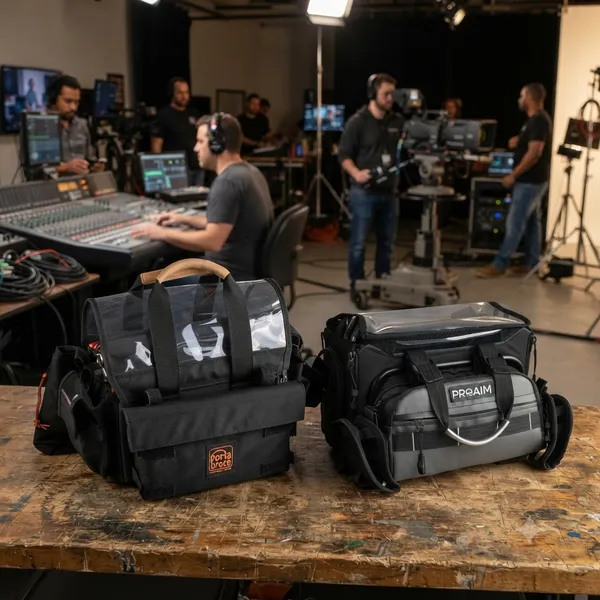
    When you are working in high-stakes field recording, how you transport and organize your mixer is just as important as the quality of the preamps inside it. A damaged recorder or a disorganized bag can end an entire day's shoot instantly. Today, we are comparing two very different approaches to audio organization: the versatile Proaim Cine Cube Audio Mixer Bag and the highly specialized PortaBrace Audio Organizer Case, specifically tailored for the Sound Devices 633 Field Mixer/Recorder.

    One of these is built for "grab-and-go" efficiency, while the other is designed as a dedicated component in a professional sound kit's ecosystem. Here is how they stack up against one another to help you decide which belongs on your next production.

    **At a Glance: Key Differences at a Glance***

    Feature Proaim Cine Cube PortaBrace Organizer Case (SD 633)
    Primary Focus All-in-one compact carrying/protection Specialized organization for high-end gear
    Best Use Case Solo operators & run-and-gun crews Professional sound departments / Heavy duty sets
    Versatility High (can accommodate various small mixers) Low (precision fitment specifically for SD 633)
    Protection Level Standard weather/impact resistance Ruggedized, heavy-duty professional grade

    The Proaim Cine Cube: Compact Efficiency on the Move If you are a solo filmmaker or part of a smaller crew that moves quickly between locations, the Proaim Cine Cube is designed to simplify your life. Its "cube" architecture aims to consolidate everything—the mixer, cables, and perhaps even spare batteries—into one manageable footprint.

    • Portability: This bag excels at being lightweight and space-efficient in a camera bag or backpack. It doesn't take up excessive room when you aren't actively recording.
    • Ease of Access: Because the design is meant for quick deployment, finding your XLR cables or small accessories within its internal compartments can be much faster than digging through an oversized gear case.
    • Best if: You prioritize speed and a compact setup where "good enough" protection meets high portability requirements.

    The PortaBrace Audio Organizer: The Sound Devices Specialist For crews working with heavy industry standards like the Sound Devices 633, nothing beats a solution designed specifically for that exact piece of hardware. PortaBrace has long been the gold standard for professional audio organizers, and their specialized cases are built to handle the rigors of high-end production environments.

    • Precision Fitment: Unlike generic mixer bags, this case is engineered around the specific dimensions, ports, and buttons of a Sound Devices 633. This means less "jiggle" inside your bag—which translates directly into better protection against impact during transport.
    • Rugged Durability: PortaBrace products are built to withstand much more punishing environments than standard nylon mixer bags; they are designed for the reality of professional sound carts and heavy field work.
    • The Organization Advantage: This isn't just a bag; it is an organizer meant to integrate into larger systems, keeping your specialized cables and specific Sound Devices accessories exactly where you expect them every single time.

    Final Verdict: Which One Should You Choose?

    Choose the Proaim Cine Cube if: You are working on lightweight productions or traveling light for run-and-gun documentary work. If saving space in your camera bag is just as important to you as protecting a small mixer, this cube offers excellent value and efficiency.

    Choose the PortaBrace Audio Organizer Case if: Your workflow centers around professional Sound Devices hardware where gear failure isn't an option. The precision fitment for the 633 provides peace of mind that general-purpose bags simply cannot match when you are operating on a major film set or in harsh conditions.

    Are you looking to streamline your solo setup, or is your primary goal building out a professional sound kit capable of handling heavy production demands?

  • Posted on
    Redefining Wireless Flexibility: A Deep Dive into the Sound Devices Astral ARX2

    Redefining Wireless Flexibility: A Deep Dive into the Sound Devices Astral ARX2

    In the ever-crowded RF environments of modern production, the ability to find a clear, reliable signal is more than a convenience—it’s a necessity. As wireless spectrum continues to shrink, Sound Devices has pushed the boundaries of portable wireless reception with the Astral ARX2.

    Designed for location sound professionals who demand high-performance, true-diversity reception in a compact, slot-in form factor, the ARX2 stands as a testament to engineering efficiency. (Sound Devices)

    The Power of SpectraBand

    The headline feature of the ARX2 is its implementation of SpectraBand technology. By providing an expansive tuning range of 470 MHz – 1525 MHz, the ARX2 effectively solves the "band-locking" dilemma that has plagued field sound engineers for years.

    Instead of juggling multiple receivers for specific regional frequency blocks, the ARX2 allows operators to quickly jump between the standard UHF TV bands and the increasingly popular 900 MHz ISM/STL bands, or even the 1.5 GHz AFTRCC band (where licensed). This agility is a game-changer for international productions or setups in highly congested metropolitan areas.

    Technical Highlights

    Beyond its broad tuning range, the ARX2 is built for the rigors of professional field work:

    • True Diversity Topology: The ARX2 utilizes two complete RF receivers per channel, providing four total receivers to ensure robust, dropout-free performance in challenging multi-path environments.

    • Brick-Wall SAW Filtering: To mitigate interference from nearby high-power sources like IFB or camera hops, the ARX2 employs low-loss, brick-wall Surface Acoustic Wave (SAW) filters. This high-discrimination front end maintains signal integrity without the need for bulky external filters.

    • GainForward Architecture: By utilizing Sound Devices’ GainForward, engineers can control transmitter gain directly from the receiver or the 8-Series mixer-recorder interface. This eliminates the need to physically access the transmitter during a take, streamlining the workflow significantly.

    • AutoAssign Functionality: When time is short, the AutoAssign feature scans the local RF environment and automatically suggests, selects, and sets the best available frequencies, reducing setup times from minutes to mere seconds.

    Integration and Connectivity

    The ARX2 is engineered for seamless integration into the Sound Devices ecosystem. It is fully SuperSlot compatible, meaning it slides effortlessly into an SL-2 module docked to an 8-Series mixer-recorder, allowing for power, audio, and control over a single connection.

    For those operating outside the 8-Series environment, the ARX2 supports a variety of connectivity options, including XLR and TA3 adapters, and the A-15PIN two-channel AES Sony camera slot adapter, ensuring it remains a versatile tool in any kit.

    The Portable Advantage: Integrating the A-XLR
    enter image description here

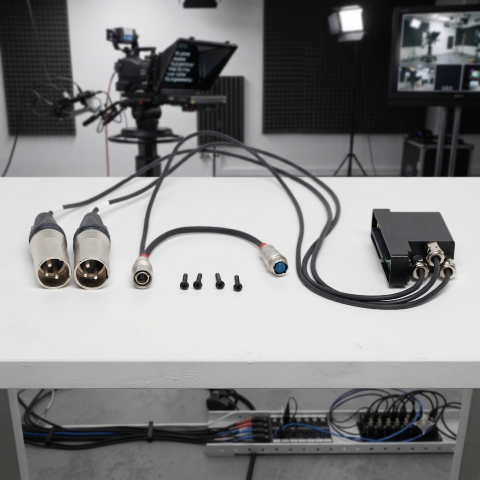
    For smaller setups or "run-and-gun" kits where a full 8-Series mixer and SL-2 module might be overkill, the Sound Devices A-XLR provides a vital bridge for the Astral ARX2. This compact adapter allows you to take the ARX2 out of the slot-in environment and into a standalone configuration, transforming it into a high-performance, two-channel receiver that fits easily into a smaller bag or shoulder rig. By providing secure XLR outputs and reliable power via the Hirose connector, the A-XLR ensures that you don't have to compromise on signal quality or the advanced features of the Astral ecosystem just because you’ve opted for a more mobile, minimalist kit. Whether you're feeding a compact mirrorless camera or a portable field recorder, the A-XLR maintains the integrity of the digital link, making it the perfect solution for solo operators who need professional-grade wireless in a low-profile footprint.

    Integrating the Astral ARX2 with the A20-TX

    The true power of the Sound Devices Astral ecosystem is realized when the ARX2 receiver is paired with the A20-TX transmitter. While the ARX2 handles the heavy lifting of signal reception, the A20-TX brings a unique set of technical advantages that simplify the workflow for the boom operator or talent. More information in an upcoming blog.

    The Verdict

    The Astral ARX2 is more than just a receiver; it is a future-proof investment for the professional sound mixer. With its combination of SpectraBand agility, robust digital modulation, and seamless integration, it provides the reliability needed to deliver clean, professional audio, no matter how crowded the spectrum becomes.

    Whether you are upgrading from the A10-RX or building a new rig, the ARX2 represents the current gold standard in portable wireless performance.

  • Posted on

    The Secret to Seamless Live Production: Mastering Interruptible Foldback (IFB)

    In the high-stakes world of live broadcasting, filmmaking, and professional event production, communication isn't just about talking—it’s about delivering the right information at the exact right time.

    If you’ve ever watched a live news anchor transition seamlessly from a chaotic breaking story to a calm, direct read, you’ve witnessed the power of Interruptible Foldback, or IFB.

    For those looking to level up their audio workflow, understanding and integrating a professional IFB system is the difference between a production that feels "amateur-hour" and one that runs with military precision.

    What is IFB, Actually?

    At its core, an IFB system is a one-way monitoring circuit designed for on-air talent, presenters, or remote contributors. It provides two distinct layers of audio: (Wikipedia)

    • The Program Feed: Usually a "mix-minus"—a live feed of the program audio that excludes the talent’s own voice (to prevent distracting echoes or feedback). (Grokipedia)

    • The Interrupt (Cue) Signal: The director or producer’s microphone. When they speak, the program feed is automatically "dipped" or muted, allowing the instruction to take priority in the talent’s ear.

    Why Integrate a Professional IFB Workflow?

    If you are currently relying on open-mic communication or inconsistent ad-hoc monitoring, it’s time for an upgrade. Here is why you should prioritize a dedicated IFB chain in your next project:

    • 1. Unmatched Clarity Under Pressure

    When a producer needs to tell an anchor that their segment is being cut short by 30 seconds, there is no room for ambiguity. A proper IFB system ensures that voice instructions are crisp, isolated, and prioritized over the background program feed.

    • 2. Efficiency and Confidence

    When talent can hear the show’s rhythm—and receive timely prompts—they can focus on their performance rather than worrying about timing. This reduces stress, eliminates long pauses, and creates a much more professional, fast-paced broadcast.

    • 3. Modern Flexibility

      • Wireless Reliability: High-quality RF transmission that handles complex, multi-user environments without interference. (Studio Economik)
      • Bluetooth Integration: New systems allow talent to use their own preferred Bluetooth monitoring solutions, removing the need for cumbersome cabling. (Where available)
      • App-Based Control: Remote configuration and frequency management via mobile apps mean you can scan for clean channels and manage your network from your smartphone, saving valuable setup time on set.

    Best Practices for Your Workflow

    To get the most out of your IFB integration, keep these three golden rules in mind:

    • Always Use Mix-Minus: Never send a full program mix back to your talent. If they hear their own voice with even a few milliseconds of latency, they will struggle to speak clearly. Always build a mix that excludes the talent’s microphone.

    • Prioritize Latency: In a live environment, latency is the enemy. Invest in professional-grade gear designed for low-latency transmission to ensure your cues align perfectly with the live action.

    • Test Your "Dips": Ensure your system’s auto-mute or "dip" functionality is tuned correctly. You want the program audio to drop enough so the director is clearly audible, but not so much that the talent loses the "feel" of the live show.

    The Bottom Line

    Whether you are running a local news broadcast, a corporate livestream, or a high-end film production, professional IFB is the bridge between the control room and the talent. By investing in a reliable, flexible system, you aren't just buying gear—you’re buying the insurance that your production will remain tight, responsive, and professional, no matter what happens on set.

    Are you currently using a wireless IFB system in your productions, or are you looking to upgrade from a traditional wired setup?

    👉 Return to RR.COM 👈

  • Posted on
    The Unsung Hero of Your Sound Kit...

    Why the Boompole Holder is Your Back’s Best Friend

    In the world of filmmaking, we often obsess over the "big" gear—the 8K cinema cameras, the high-end shotgun mics, and the pristine field mixers. But if you spend any time on a set, you know that the most crucial piece of kit is often the one that doesn't get a mention in the credits: the boompole holder.

    enter image description here

    It’s humble, it’s simple, and it’s frequently overlooked. But for any sound recordist or solo filmmaker, the boompole holder is the piece of equipment that saves your career—and your spine.

    What is a Boompole Holder?

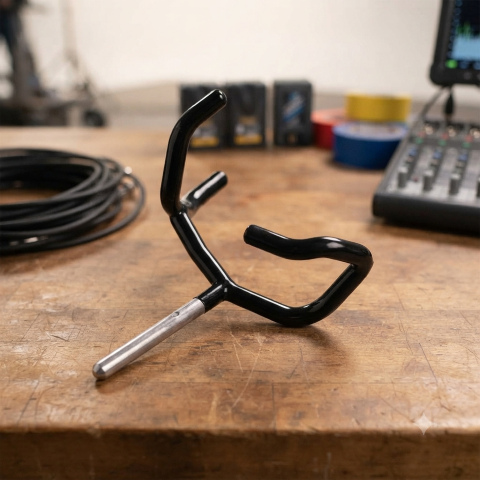
    At its core, a boompole holder is a mechanical clamp system that secures your pole to a C-stand, light stand, or tripod. By moving the weight of the mic from your weary arms to a sturdy stand, it transforms your setup from a "human-powered rig" into a rock-solid, repeatable audio station.

    The Virtue of "Set It and Forget It"

    There are moments on set where a human boom operator is indispensable—following moving talent through a house, for instance. But for the vast majority of static setups—interviews, fixed-position hosting, or stationary b-roll—a boompole holder is actually superior to a human.

    • Repeatability: Once you lock the angle and distance, it stays there. You don't have to worry about a tired operator’s hand drifting three inches to the left mid-take.

    • Precision Placement: It allows you to get the microphone closer to the subject’s mouth than a human might comfortably hold it for a 30-minute interview, drastically improving your signal-to-noise ratio.

    • Solo Power: If you’re a one-person crew, you aren't sacrificing audio quality for lack of a second pair of hands. You are the camera op, the lighting tech, and the sound mixer, all at once.

    Saving Your Back (And Your Bacon)

    Let’s be honest: boompole operation is brutal. The "H-position" or the overhead reach is a recipe for chronic shoulder, neck, and lower back issues. (Soundrolling)

    When you use a holder during long sessions, you’re not just being lazy; you’re engaging in injury prevention. By offloading that weight between takes—or during the entire interview—you keep your muscles fresh. When you do need to go handheld for an action scene, you'll have the energy and stability to actually hit your marks, rather than shaking from fatigue.

    As for "saving your bacon"? A professional-grade holder uses a positive-locking jaw system. This ensures that when the wind kicks up or someone bumps the stand, your thousand-dollar microphone doesn't come crashing down onto the concrete. It keeps your gear safe and your audio consistent, preventing the dreaded "we'll fix it in post" conversation.

    Pro-Tips for Your Setup:

    • Don't Skip the Shock Mount: A holder secures the pole, but it doesn't isolate the mic from vibrations traveling through the floor or the stand. Always use a proper shock mount (like a Rycote Lyre) between the pole and the mic.

    • Mind the Diameter: Before buying, check the outer diameter of your boom pole. Most professional poles fall between 25mm and 32mm. Ensure your holder’s jaws can accommodate your specific pole for a secure, non-slip grip

    • Use a C-Stand: If you’re mounting a heavy mic, use a heavy-duty C-stand and sandbag. Your "bacon" is only as safe as the stand the holder is attached to!

    Next time you’re building your kit, don't overlook the lowly boompole holder. It won't win any beauty contests, but it will be the reason you can still move your shoulders after a 12-hour day.

    👉 Return to RR.COM 👈

  • Posted on
    Beyond the Standard: A Deep Dive into A20-Monarch, BOWTIE, and BF1

    The Butterfly Effect: Comparing Wideband Antennas for Location Sound

    Introduction

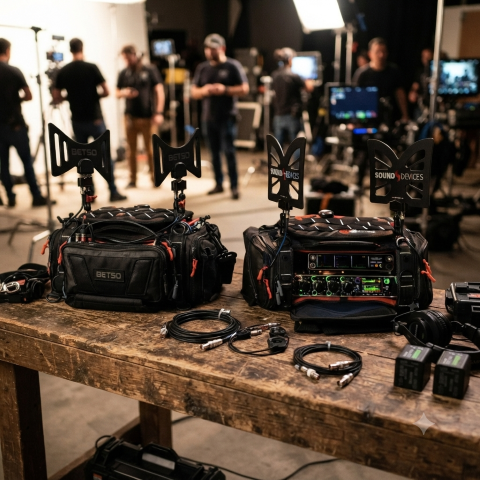
    In the world of location sound, the antenna is your first line of defense. As the RF landscape becomes increasingly crowded—squeezed by spectrum auctions, 5G rollouts, and the constant hum of electronic noise—the choice of hardware mounted to your sound bag has never been more critical. The "butterfly" style omnidirectional antenna has become the industry standard for its portability, durability, and reliable performance. But with options ranging from the ultra-wideband A20-Monarch to the filter-integrated Betso BOWTIE, which one truly deserves a spot in your kit? In this post, we’ll compare the top contenders to help you decide how to keep your signal clean, strong, and interference-free on your next production.

    At a Glance: Comparison Table

    Feature Sound Devices A20-Monarch Betso BOWTIE Deity BF1
    Freq. Range 470 – 1600 MHz 470 – 700 MHz 470 – 1000 MHz
    Inbuilt Filter None Yes (700 MHz Low Pass) None
    Best For Ultra-wideband needs (SpectraBand) High-interference environments Value & broad compatibility

    Key Differences

    1. Frequency Range & Versatility

    • Sound Devices A20-Monarch: The clear winner for frequency range. It is designed to cover the entire SpectraBand range (up to 1600 MHz), making it the most future-proof option if you are using wideband gear that operates outside the standard UHF TV band. (Everything Audio Europe)
    • Deity BF1: Offers a very respectable 470 MHz – 1000 MHz range, which covers virtually all standard professional wireless microphone systems currently on the market. (B&H)
    • Betso BOWTIE: Has the most limited range (470 – 700 MHz). It is specifically engineered for the traditional UHF spectrum. (BETSO)

    2. Interference Mitigation

    • Betso BOWTIE: This is its "secret weapon." It features a built-in 700 MHz low-pass filter. In modern production environments where LTE/5G and other high-frequency signals often cause interference, this hardware filter helps clean up your signal before it even hits your receiver or multicoupler.

    • A20-Monarch & BF1: Neither of these include an integrated filter. If you operate in extremely congested RF environments, you may need to add an external band-pass filter to your signal chain when using these antennas.

    3. Build & Mounting

    • Betso BOWTIE & Deity BF1: Both are rated IP65, meaning they are dust-tight and protected against water jets, making them excellent choices for outdoor field work in varying weather conditions.

    • Mounting: All three utilize standard 1/4"-20 threading, making them compatible with most sound bag mounting hardware. The A20-Monarch and BF1 kits are particularly well-regarded for the inclusion of versatile, high-quality articulating arms in the box.

    Pro-Tip: The Importance of Cable Maintenance

    While we often focus on the antenna's frequency range and gain, your signal is only as good as the cable connecting it to your receiver.

    enter image description here

    Pro-Tip: If you’re using high-quality antennas like these, don't pair them with cheap, high-loss coax. Use RG-174 or RG-316 cables with high-quality, properly crimped BNC connectors. More importantly, keep your cable runs as short as possible. Every foot of cable between your antenna and your distribution system introduces signal loss (attenuation). Even the best antenna in the world will underperform if it's struggling to push a signal through ten feet of poor-quality, poorly shielded cable. Aim to keep your cable runs under three feet for your sound bag setup, and always inspect your BNC connections for signs of strain or corrosion at the start of every production day.

    Which one should you choose?

    • Choose the Sound Devices A20-Monarch if: You are invested in the Sound Devices Astral/SpectraBand ecosystem or require the absolute widest frequency coverage possible (up to 1.6 GHz).

    • Choose the Betso BOWTIE if: You work primarily in busy urban areas or near cellular towers. The integrated 700 MHz filter is a significant advantage for maintaining a clean noise floor in high-interference environments.

    • Choose the Deity BF1 if: You want the best balance of price, performance, and broad compatibility. It is an excellent "workhorse" antenna that handles the standard UHF range (and slightly above) with ease and comes in a complete, ready-to-use kit.

    👉 Return to RR.COM 👈

  • Posted on
    Choosing The Right Headphones, the Sony MDR-7506 vs. the Audio-Technica ATH-M50x

    Studio Standard vs. Modern Workhorse: Choosing Your Field Recording Headphones

    For professional field recording, your choice of headphones is critical. You need gear that is reliable, provides an accurate representation of your audio, and offers sufficient isolation from the environment.

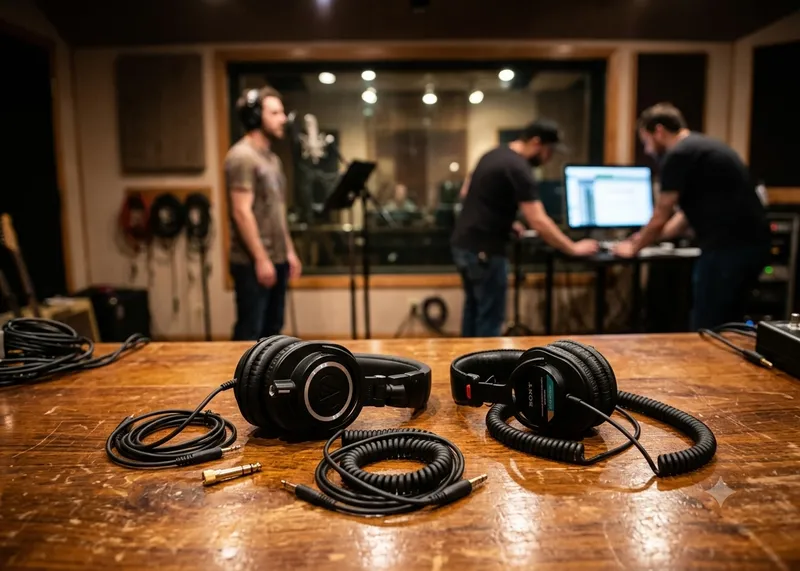
    The Sony MDR-7506 and the Audio-Technica ATH-M50x are two of the most popular studio monitors, but they serve slightly different purposes in the field.

    At a Glance: Comparison Table

    Feature Sony MDR-7506 Audio-Technica ATH-M50x
    Best For Critical monitoring & accuracy Monitoring & versatile use
    Sound Profile Bright, analytical, "standard" Boosted bass/treble, "fun"
    Durability Proven, but plastic-heavy Robust "tank-like" construction
    Cable Non-detachable, long coil Detachable (3 options included)
    Comfort Lightweight, high clamping force Moderate weight, snug fit
    Portability Folds compact Folds & swivels

    Deep Dive: Professional Field Recording

    The Case for the Sony MDR-7506

    The MDR-7506 has been an industry standard for decades. If you walk onto a film set or a professional broadcast interview, you are almost guaranteed to see these around someone's neck. (Charles Cleyn)

    • Pros:
      • Analytical Clarity: They are known for a "brighter" sound that highlights mid-to-high frequencies. In field recording, this makes it easier to spot background noise, handling noise, or vocal sibilance that you might otherwise miss.
      • Industry "Language": Because so many professionals use them, you gain a common frame of reference. If a sound sounds "off" on a 7506, other engineers likely hear the same thing.
      • Portability: They fold up very compactly and are lightweight, which is a major bonus when hiking or moving through tight shooting spaces. (PetaPixel)

    • Cons::
      • The Cable: The cable is fixed. If it snaps or frays, you have to solder a replacement yourself or pay for a repair.
      • Fatigue: The high-frequency emphasis can lead to "ear fatigue" during very long recording days. (Home Studio Basics)

    The Case for the Audio-Technica ATH-M50x The M50x is a more modern, consumer-friendly evolution. It is arguably more versatile if you are doing a mix of field recording, editing, and casual listening.

    • Pros:
      • Detachable Cables: This is the biggest advantage for field work. It comes with multiple cable options (coiled, short, long), making it easy to adapt to your recorder without having yards of excess cable snagging on gear.
      • Sturdy Build: They are physically robust. They handle the "toss it in the bag" abuse of field production quite well.
      • Low-End Presence: If you are recording ambience or sound effects with deep sub-bass frequencies, the M50x provides a more powerful bass response that can help you gauge the "weight" of a recording better.

    • Cons::
    • Sound Coloration: The "V-shaped" sound (boosted bass and treble) can sometimes mask issues in the midrange where critical dialogue or subject matter lives.
    • Clamping Force: Some users find the clamping force a bit intense during the first few weeks of use, which can become uncomfortable over an 8-hour shift.

    The Verdict for Field Work

    • Choose the Sony MDR-7506 if: You are primarily recording dialogue, interviews, or location sound where hearing subtle, high-frequency details (like unwanted background buzz or mouth clicks) is your top priority. Their "analytical" sound is a tool that keeps you honest about your signal.

    • Choose the Audio-Technica ATH-M50x if: You need a "do-it-all" headphone. If your workflow involves recording in the field and then immediately sitting down at a laptop to edit, or if you need a headphone that you can also enjoy for music production and casual use, the M50x is more versatile.


    Pro-Tip for Field Recordists: No matter which pair you choose, invest in high-quality third-party earpads (like velour or memory foam replacements). Stock leatherette pads can get sweaty and uncomfortable in hot field conditions, and upgrading them is a common practice among pros to extend both comfort and the lifespan of the headphones.

    👉 Return to RR.COM 👈

  • Posted on
    The Unsung Hero of the Gear Bag

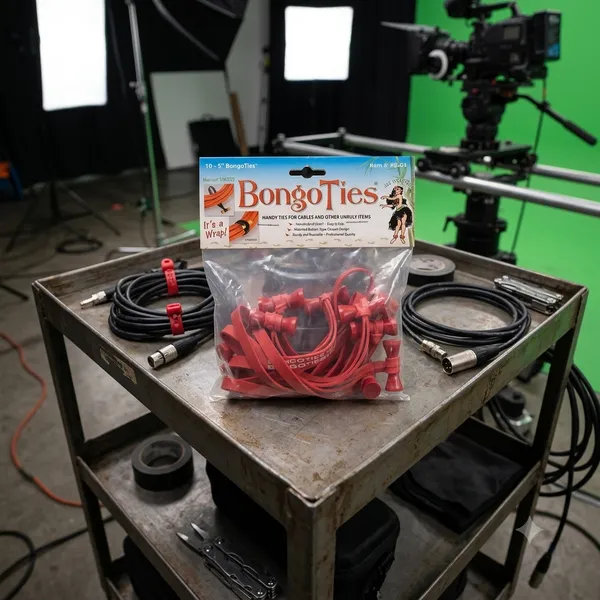
    The Unsung Hero of the Gear Bag: Why You Need Bongo Ties

    If you work in film, photography, music, or IT, you already know the nightmare: a tangled bird's nest of extension cords, HDMI leads, and audio cables sitting at the bottom of your bag.

    While the world tries to sell us complex plastic clips and disposable zip ties, the film industry's best kept secret is beautifully simple, incredibly cheap and practically indestructible.

    Meet the Bongo Tie

    Brilliant design in its simplest form.

    Invented by a pro photographer who was tired of wrestling with sticky tape and flimsy hook and loop straps, a bongo tie consists of just two elements

    1. A heavy duty, highly durable, Hevea rubber band.

    2. A patented flared bamboo pin that acts as a toggle.

    There are no gears, no hooks, no plastic to snap in cold weather. You just wrap the rubber band around your cables, loop it over the bamboo flared ends, and it snaps, locked under its own tension.

    4 reasons, they beat everything else.

    • No sticky residue: Unlike gaffer tape or electrical tape, they leave zero residue on expensive cables.
    • True one-handed operation: You can easily lock or release them with one hand while holding a heavy coil of wire with the other.
    • Reusable for years: Zip ties are a single use plastic waste nightmare. Bongo ties can be used hundreds of times before the rubber finally loses its snap.
    • The flared pin advantage: because the bamboo toggle is flared on both ends, the loop can't accidentally slide off, even under heavy vibration.

    Beyond Cables: Through Creative Uses

    While they were built for cords, anyone who owns a pack quickly discovers they are the ultimate "fix-it" tool. Production crews use them to strap wireless receivers to camera rigs, musicians use them to secure loose mic stands, and campers use them to lash gear to backpacks.

    In a world full of over-engineered gadgets, the Bongo Tie is a refreshing reminder that sometimes, the simplest solution is the best one.