Inside Audio

Mixers

Only the best equipment for professionals on location.

  • Posted on
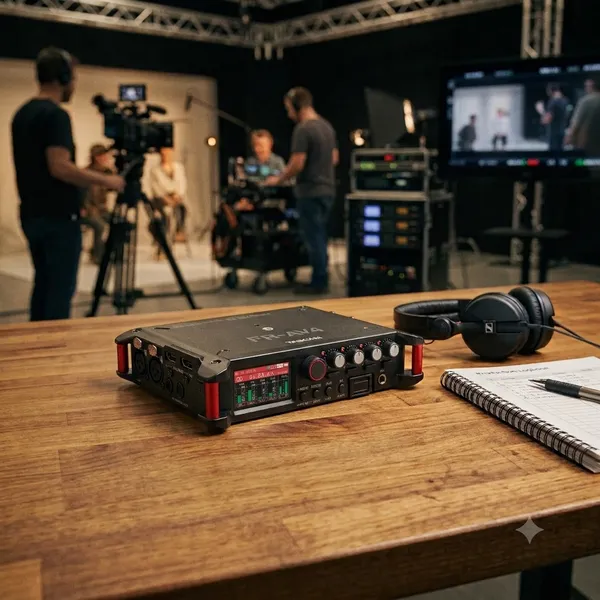
    A Deep Dive into the TASCAM FR-AV4

    Bridging the Gap Between HDMI and Pro Audio: A Technical Deep Dive into the TASCAM FR-AV4

    For years, location sound recordists and videographers have operated in parallel but separate universes. On one side, we have high-fidelity, dual-ADC, 32-bit float audio recorders. On the other, we have ultra-high-definition 4K/8K camera ecosystems. Syncing the two usually requires expensive tentacle-style timecode boxes or tedious post-production alignment.

    Enter the TASCAM FR-AV4.

    Positioned as a direct competitor to the Zoom F6 and Sound Devices MixPre series, this 4-channel, 6-track field recorder introduces something we haven’t quite seen in this form factor: native, clock-synchronized HDMI architecture. Let’s break down the engineering and hardware architecture under the hood. (NewsShooter)

    1. The Core Audio Architecture: Dynamic Range & Gain Stages

    The FR-AV4 features four XLR/TRS combo inputs backed by TASCAM’s proprietary Ultra HDDA (High Definition Discrete Architecture) preamps. (Tascam)

    • The Math on Noise: The preamps achieve an Equivalent Input Noise (EIN) of -127 dBu. When paired with high-sensitivity condenser microphones (like a Sennheiser MKH50), the self-noise of the recorder is essentially negligible.
    • Dual A/D Converters: Each channel utilizes a dual analog-to-digital converter setup feeding a 32-bit float pipeline.
    • Headroom and Clipping: The system boasts an analog dynamic range of 133 dB. Maximum input levels sit at +4 dBu for microphone signals and a massive +24 dBu for line-level inputs. Because of the 32-bit float integration, clipping at the converter level is mathematically impossible.

    ⚠️ Technical Reminder: While 32-bit float prevents digital clipping at the recorder stage, it cannot save you if you over-drive the physical capsule of the microphone itself. Proper mic positioning and attenuation still matter.

    2. The HDMI Ecosystem: Clock Sync & Video Passthrough

    The most compelling engineering choice on the FR-AV4 is the inclusion of twin HDMI 2.1 ports (In / Out). This isn't just for routing video; it serves as a digital handshake for absolute hardware synchronization. (PodcastVideos)

    Video Passthrough & Audio Embedding The FR-AV4 supports uncompressed 4K and 8K video passthrough. As the video signal transits through the device, the FR-AV4 can inject its pristine, multi-track audio directly into the HDMI metadata stream. If you are routing the output to a field monitor/recorder like an Atomos Shogun or Blackmagic Video Assist, your high-res audio is printed directly into the video file simultaneously.

    Master Clock and Record Triggers By utilizing a shared master clock over HDMI (TASCAM Patent No. 6547550), phase drift between video frames and audio samples is eliminated. Furthermore, the FR-AV4 reads the camera’s flags, meaning pressing "Record" on your Sony, Canon, or Nikon camera instantly fires up the 6-track recording engine on the TASCAM.

    3. Timecode Architecture & Thermal Performance

    For workflows not utilizing HDMI, the FR-AV4 houses a fully independent timecode generator capable of LTC Jam Sync.

    • The Component: It utilizes a high-precision Temperature-Compensated Crystal Oscillator (TCXO).
    • The Caveat: The TCXO is strictly rated for a standard operating environment of 0°C to 40°C. If you are shooting a documentary in sub-zero environments, the lack of a specialized temperature-controlled oscillator means you should expect slight timecode drift, requiring more frequent jams.

    4. Digital Signal Processing (DSP) & Ecosystem Expansion

    The unit is capable of recording up to 192 kHz sampling rates across 6 tracks (Inputs 1–4 + a stereo master bus) onto SDXC cards up to 512 GB.

    • Onboard DSP: Every channel features independent low-cut filtering, 4-band EQ, noise gating, and digital limiting before the master bus.
    • Auto Mix (Firmware v1.10+): TASCAM implemented a gain-sharing Auto Mix function. It dynamically attenuates unused open microphones to drastically mitigate comb filtering and background ambient noise during multi-person dialogue.
    • Ambisonics: For spatial audio, VR, and 360 production, the unit supports native decoding and recording of A-format and B-format (AmbiX / FuMa).
    • HDMI Cascading: If 4 XLR inputs aren't enough, you can cascade two FR-AV4 units together via HDMI. This links their internal sample clocks and unifies the record trigger, expanding your system to an 8-input field rig.

    5. Power Management & Data Safety

    Field recording demands redundancy. The FR-AV4 addresses this via dual-source options and an automated file infrastructure:

    • USB-C Bus Power: Can run indefinitely on a standard Power Delivery (PD) power bank.
    • Quick-Swap AA Trays: Uses the BH-4AA sled. Running 2450mAh NiMH batteries with a single +48V phantom-powered mic will net you roughly 7 hours of runtime.
    • The 20-Second Safety Net: To protect against catastrophic power failure (e.g., a pulled cable), the FR-AV4 utilizes an Auto File Save algorithm that closes and flushes the WAV header to the SDXC card every 20 seconds. If power cuts, you lose a maximum of 20 seconds of audio.

    Technical Summary Matrix

    Feature Specification / Technical Detail
    Inputs 4x XLR/TRS Combo (Ultra HDDA)
    Max Track Count 6 Tracks (4 Iso + Stereo Mix)
    Dynamic Range 133 dB (Dual A/D Converters)
    Preamp EIN -127 dBu
    Bit Depth / Sample Rate 32-bit Float up to 192 kHz
    HDMI Support HDMI 2.1 (4K/8K Passthrough, Clock Sync, Rec Trigger)
    Wireless Control App Control & BT Audio Monitoring via optional AK-BT2

    6. Ecosystem Expansion: Wireless Control & The Bluetooth Conundrum

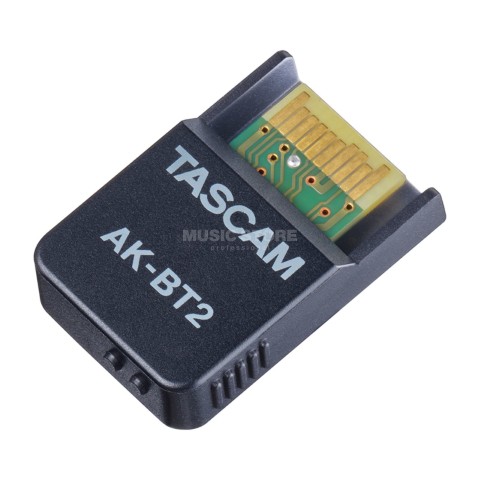
    While the physical chassis of the FR-AV4 handles traditional wired inputs, expanding into modern, agile field workflows requires unlocking its wireless capabilities. This is achieved via a dedicated front-panel slot that accepts the optional AK-BT2 Bluetooth 5.0 (Low Energy) adapter. enter image description here (Image property of Musictstore.com)

    Plugging in this dongle bifurcates the recorder’s operational capabilities into two distinct wireless domains: Control/Metadata Data Streams and Real-Time Linear Audio Monitoring.

    The TASCAM Recorder Connect App Pipeline

    Operating over Bluetooth LE, the free TASCAM Recorder Connect app (available across iOS, iPadOS, and Android) shifts the FR-AV4 from a solo bag-recorder to a multi-unit node system.

    • Multi-Unit Topology (REC-LINK): The app can establish simultaneous control links with up to five distinct TASCAM devices (including combinations of the FR-AV4, the 2-channel FR-AV2, and the DR-10L Pro pocket recorders). The integrated REC-LINK function allows you to issue a master global transport command—punching record on the app or on any hardware unit instantaneously flags record across all five synchronized nodes.
    • Metadata Inject Engine: Rather than fighting the tiny 1.9-inch hardware touchscreen to name takes, the app allows engineers to rapidly input and edit industry-standard iXML and BEXT metadata (Project Name, Scene, Take, and custom Notes) directly from a tablet or smartphone. This metadata prints cleanly into the broadcast WAV headers in real time.
    • Remote UI Visualization: Production mixers can monitor input status and view scrolling, real-time visual waveforms across all channels simultaneously from up to roughly 30 feet away, saving the mixer from constantly having to peek over the camera op's shoulder.

    Wireless Audio Monitoring & Atomos Sync The AK-BT2 also allows the FR-AV4 to broadcast audio wirelessly to standard Bluetooth headphones, earbuds, or studio monitors, opening up a highly flexible dual-monitoring workflow:

    💡 Dual Monitor Configuration: The hardware internal amplifier allows the 3.5mm physical headphone jack and the AK-BT2 wireless transmitter to work in parallel. Two crew members (e.g., the sound recordist and the director) can monitor the source mix simultaneously without a physical hardware splitter

    To balance the volatile nature of Bluetooth RF environments, TASCAM allows you to select from three distinct optimization modes inside the wireless menu:

    1. Connectivity Priority: Prioritizes link stability by aggressively buffering data packets—ideal for congested RF environments but adds a significant latency penalty.

    2. Sound Quality Priority: Allocates maximum bandwidth to the standard A2DP / SBC codec stream for high-fidelity critical listening.

    3. Latency Priority: Drops the internal buffer size to tighten the sync window between the live acoustic environment and the monitor output.

    The Reality of Bluetooth - Latency on Set

    From a strict engineering standpoint, developers must be candid about the limitations of standard Bluetooth audio transmission. Because the AK-BT2 utilizes standard Bluetooth 5.0 (SBC codec) rather than proprietary ultra-low-latency 2.4 GHz protocols, there will always be a noticeable latency delay.

    While the latency mode mitigates this as much as possible, monitoring dialogue via Bluetooth earbuds will introduce a subtle lip-sync delay relative to the raw video frame or real-life speech. For dialogue mixers trying to spot subtle microphone rustle or clothing noise exactly when it happens, the wired 3.5mm zero-latency output remains mandatory. The Bluetooth audio feed should be reserved for reference monitoring or directing staff who don't require microsecond phase alignment.

    Finally, for timecode-focused sets, the AK-BT2 pulls double duty by establishing a wireless sync handshake with supported Atomos UltraSync BLUE devices, providing a highly reliable wireless timecode bridge alongside the app data. (B&H)

    Suggested Video for Deeper Context For a visual and procedural walk-through of how the front-panel mixer operates and how to interface these modules, check out this Tascam FR-AV4 Overview & Features Video. It provides an excellent layout breakdown showing exactly where the optional AK-BT2 installs beneath the master volume knobs.

    The Verdict

    The TASCAM FR-AV4 represents a massive architectural pivot. While it lacks some of the premium headphone amplifier power found in the Sound Devices MixPre series, its unique ability to live cleanly inside an HDMI video workflow makes it incredibly disruptive for modern multi-cam indie film and documentary sets.

    👉 Return to RR.COM 👈

  • Posted on
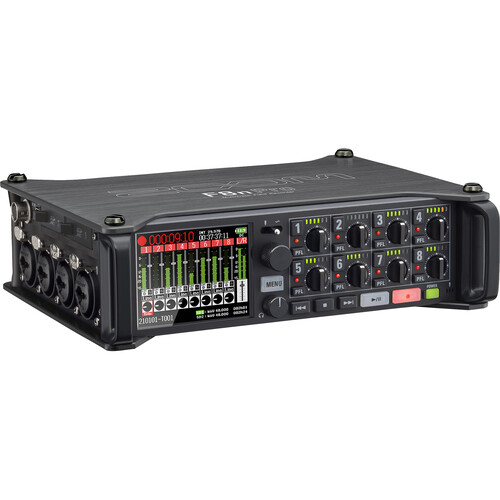
    Is the Zoom F8n Pro Still the Value Heavyweight?

    Virtues, Vices, and 32-Bit Float: Is the Zoom F8n Pro Still the Value Heavyweight?

    Introduction

    For years, the location sound industry was divided into two distinct tiers: ultra-affordable, prosumer handy recorders and multi-thousand-dollar elite field mixers. When Zoom launched the F-series, they intentionally broke that barrier. The Zoom F8n Pro represents the peak of this evolution.

    By marrying high-channel capacity with dual A/D converters and 32-bit float recording, the F8n Pro promises bulletproof audio that cannot clip. But is it a true replacement for a high-end production bag, or are there hidden workflow compromises? Let’s break down the virtues and drawbacks of this field recording powerhouse. (B&H)

    The Virtues (The Pros)

    1. 32-Bit Float: Bulletproof Dynamic Range The headline feature of the "Pro" moniker is the dual analog-to-digital (A/D) converters paired with 32-bit float recording.

    • What it means: You essentially no longer have to set input gain to prevent digital clipping.
    • The Reality: If a scene transitions from a quiet whisper to a sudden explosion, the F8n Pro captures the entire waveform without distortion. Even if the file looks clipped in your DAW, pulling down the gain slider recovers the audio perfectly. For solo shooters or fast-moving indie sets, this is an absolute lifesaver. (Sweetwater)

    2. Form Factor and Build Quality

    Unlike the smaller MixPre series, which often places crucial knobs on the side, the F8n Pro is built strictly for a sound bag configuration.

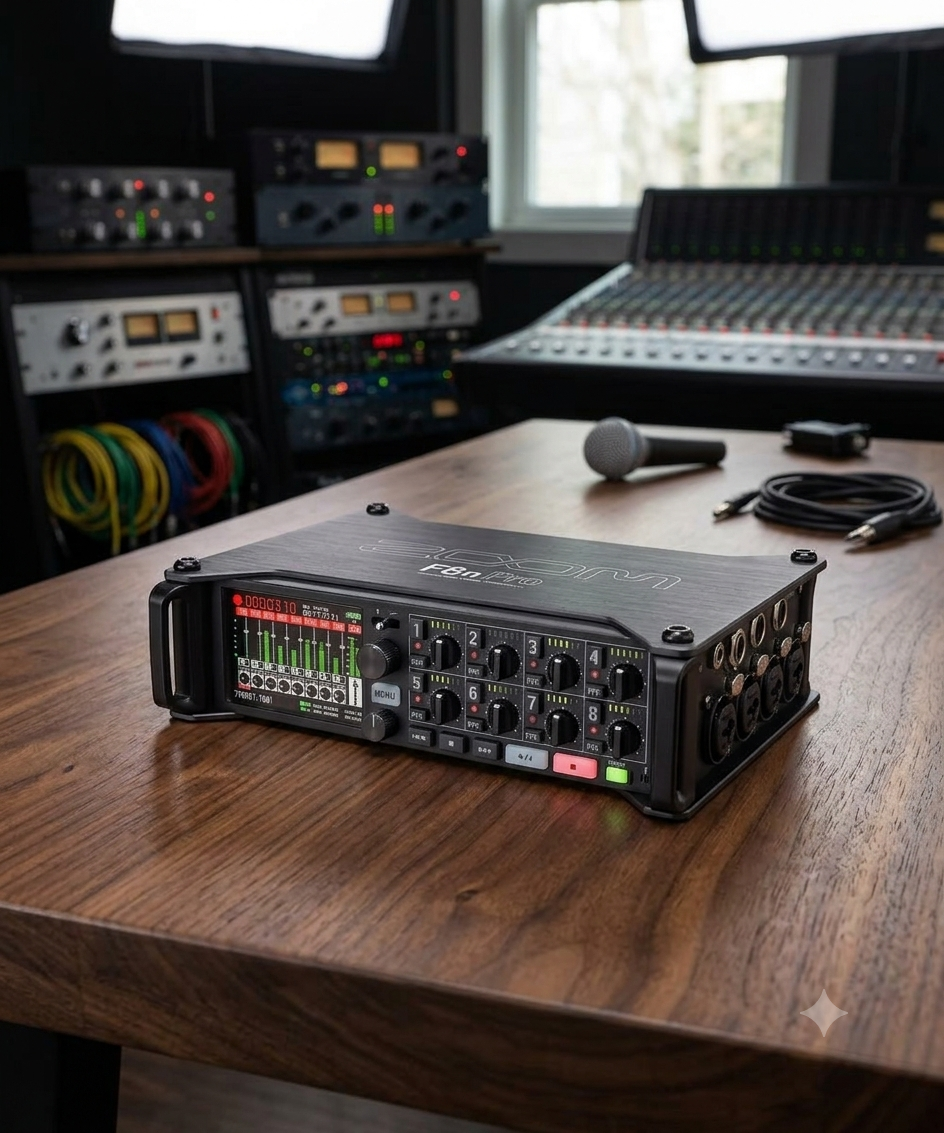
    • All 8 locking Neutrik XLR/TRS combo jacks are cleanly split on the sides (Channels 1–4 on the left, 5–8 on the right).
    • The front panel remains clear for channel knobs, LED meters, and the crisp, highly visible color display.
    • The aluminum chassis feels rugged enough to take "into battle" on demanding field shoots.

    3. Comprehensive Timecode

    Timecode is the barrier to entry for professional film sets, and Zoom nailed it here. The F8n Pro utilizes a temperature-compensated crystal oscillator (TCXO) that generates timecode accurate to 0.2 ppm. Crucially, it holds its clock for up to two hours after being powered down—meaning you can swap batteries at lunch without losing sync with your cameras. (Wav.Report)

    4. Advanced Software Tools: AutoMix and Ambisonics

    The inclusion of an AutoMix algorithm automatically adjusts the gain of active vs. inactive microphones. This is a massive time-saver for multi-person podcasts or panel discussions, significantly reducing background spill and room tone phase issues in real time. For VR and spatial audio designers, it also handles internal Ambisonic decoding seamlessly. (AudioTechnology)

    The Drawbacks (The Cons)

    1. Ergonomics: Tiny Knobs for Big Hands While the layout is structurally great for a bag, the physical control knobs are undeniably minuscule.

    • Adjusting individual channel levels or riding faders on a fast-paced set can feel incredibly fiddly, especially if you are wearing gloves.
    • The Fix: To get true physical mixing capabilities, you almost have to buy the external Zoom F-Control (FRC-8) mixing desk, adding bulk and cost to your setup.

    2. Comms, Routing, and Output Ecosystem This is where the line between "indie tool" and "Hollywood standard" becomes clear.

    • Outputs: The F8n Pro uses a mix of TA3 connectors for its main outputs and a single 3.5mm jack for its sub-outputs. For complex sets requiring multiple distinct monitoring feeds (e.g., separate mixes for the Director, Script Supervisor, and Boom Operator), the routing matrix can quickly become limiting.

    • Comms: Setting up internal communication or a dedicated talkback/private line loop to your boom op through the F8n Pro requires complex workarounds compared to higher-end sound mixers.

    3. The Digital Signal Path Catch-22 Because the unit relies on digital processing for its high-pass filters and limiters, your analog microphone signal is converted to digital before these filters are applied. While the 32-bit float system mitigates clipping issues, purists note that you lack the warm, analog limiter stage found in premium competitors. (Reddit)

    4. Bizarre Input Layout A minor but persistent annoyance for veteran audio engineers is Zoom’s layout sequence. When looking at the left panel, the inputs read from right to left rather than left to right. It breaks decades of muscle memory and can lead to minor confusion when patching cables in a dark bag.

    Power Infrastructure and Rigging: The Three-Way Lifeline In location sound, power failure is the ultimate sin. Zoom engineered the F8n Pro with an exceptionally flexible power infrastructure, borrowing a page directly from high-end sound carts. It utilizes a tri-tier power management system that allows seamless fallovers.

    enter image description here

    1. The Pro Standard: Hirose 4-Pin DC Input For serious bag setups, the inclusion of a dedicated HIROSE HR10A-7R-4S 4-pin connector is a major selling point. (ZOOM)

    • The Specs: It accepts a wide input voltage range of 9V to 18V DC.
    • The Workflow: This allows you to integrate the F8n Pro directly into a professional distribution system (like an eSMART, Remote Audio BDS, or an NP-1/smart battery system).
    • The Smart Failover: The recorder features an internal, software-controlled voltage threshold setup. If your external smart battery runs dry, the F8n Pro automatically and silently drops back onto its internal power array without dropping a single sample of audio.

    2 The Internal Array: 8x AA Batteries When you don't want to rig up an external power distribution system, or if you need an absolute fail-safe backup, the bottom of the chassis features a slide-out sled accommodating 8 AA batteries.

    • Crucial Tip: You must manually select your battery chemistry in the system menu (Alkaline, NiMH, or Lithium) so the unit can accurately calculate the remaining voltage curve and warn you before shutting down.

    3. AC Power For desktop use, podcast studios, or cart setups near mains power, it ships with the Zoom AD-19 (12V DC, 2A) barrel plug adapter.

    Real-World Power Draw & Battery Life Benchmarks The F8n Pro has a maximum total power consumption rating of 15W. However, its actual battery performance scales drastically depending on how hard you push the digital signal processing, how many preamps are active, and whether you are forcing the unit to supply 48V phantom power. (Markertek)

    Here is what you can realistically expect from a fresh set of 8 AA batteries:

    Setup / Rigging Scenario Alkaline AAs NiMH AAs (2500 mAh) Lithium AAs
    Light Load ~6 to 7 hours ~8 to 8.5 hours ~12 to 13.5 hours
    (2 Channels, 48kHz, Phantom OFF, Timecode OFF, Screen Low)
    Standard Film Set Load ~4.5 to 5 hours ~6 to 7 hours ~9.5 to 10 hours
    (8 Channels, 48kHz, Phantom OFF, Screen Medium)
    Maximized Field Load ~30 mins ~1 to 1.5 hours ~2 to 2.5 hours|~9.5 to 10 hours
    (8 Channels, 144kHz/192kHz, All Phantom 48V ON, Timecode Free Run, Screen Bright)

    ⚠️ Pro-Tip for the Field Running 8 channels with continuous 48V phantom power at 192kHz sample rates will chew through standard Alkaline AA batteries in roughly 30 minutes. If you are tracking a heavy musical ensemble or a complex ambient soundscape in high resolution, avoid AAs entirely and run a high-capacity LiFePO4 or Lithium-ion pack via the Hirose input. A standard 48Wh external battery pack can easily push the F8n Pro past 12 to 14 hours of continuous multi-channel runtime.

    Feature Comparison Table

    Feature Zoom F8n Pro Standard Pro Competition (e.g., Sound Devices 8-Series)
    Price Point ~$700 - $1,000 $4,000+
    Resolution Up to 32-bit Float / 192 kHz Up to 32-bit Float / 192 kHz
    Preamps Clean, low-noise (+75dB max gain) Ultra-premium, discrete analog topologies
    Routing Flexibility Moderate (Main TA3 + Sub 3.5mm) Complex (Multiple independent buses/XLR/TA3)
    Comms / Talkback Limited / Basic Slate Mic Limited / Basic Slate Mic

    App Control & Metadata: Solving the Ergonomic Problem?

    While the F8n Pro’s miniature physical knobs can be a bottleneck on set, Zoom offers a remarkably seamless software solution to bypass them entirely: the F8 Control App (available for iOS and Android). (Google Play) By connecting to the recorder via built-in Bluetooth LE, your smartphone or tablet essentially transforms into a high-resolution, large-scale wireless monitoring control surface.

    1. Remote Mixing and Level Monitoring Instead of fumbling with the tiny dial layout on the front panel, the app gives you a highly responsive, multi-touch mixer screen. You can effortlessly adjust trim levels, pan settings, and track faders on the fly. (Apple App Store)

    • The Workflow Advantage: This means you can keep the F8n Pro securely zipped up inside a protective weather-proof sound bag while managing your entire mix comfortably from a phone clipped to your harness or a tablet mounted on a stand.

    2. High-Speed iXML Metadata Entry Entering metadata via a push-and-turn encoder knob on a tiny recorder screen is a notorious form of cognitive torture on set. The F8 Control App fixes this by unlocking your mobile device's native touch keyboard.

    • You can instantly type out complex scene numbers, track names, notes, and circle takes into the broadcast-standard iXML metadata architecture.

    • Having clean, accurately labeled audio files that mirror the camera’s slate format saves your editor hours of tracking in post-production. The app also lets you sync the recorder’s internal date and time clock directly to your device with a single tap.

    Conclusion: The Final Verdict

    The Zoom F8n Pro is an undisputed value champion. If you are an indie filmmaker, documentarian, corporate video producer, or immersive sound designer, this machine offers roughly 90% of the field performance of an elite-tier recorder at a fraction of the cost. The dual-converter 32-bit float safety net alone makes it a bulletproof investment for fast-moving crews.

    However, if your daily workload consists of high-track-count narrative television, complex commercial sets requiring heavy real-time comms routing, or extensive camera hops, the hardware’s physical scaling limits will eventually push you toward a premium upgrade. But until you reach that high-budget threshold, the F8n Pro remains the ultimate power-to-price heavy lifter in location audio.

    For a visual walkthrough on utilizing these tools in a production environment, you can check out this guide on Working On a Film or Theatre Set with the Zoom F8n Pro Control App, which demonstrates how utilizing a tablet interface speeds up workflow when the hardware is tucked away inside an audio bag.

  • Posted on
    Pro Audio on an Indie Budget

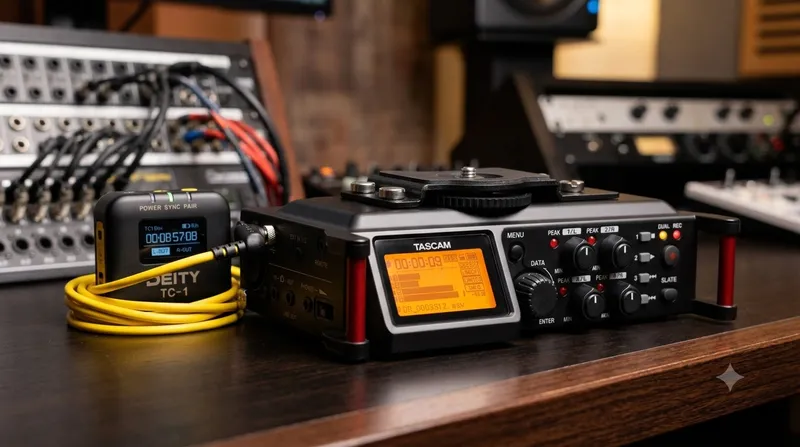
    Pro Audio on an Indie Budget: How to Rig the Tascam DR-70D and Deity TC-1 for Perfect DSLR Sync

    We’ve all been there. You’re shooting on a crisp mirrorless or DSLR camera, the image looks beautiful, but your audio workflow is a total mess. You want the pristine quality of external XLR microphones, but manually lining up clapperboards or relying on “sync by waveform” features in post-production can slow your editing workflow to a crawl.

    If you don’t have thousands to drop on a high-end cinema camera with built-in timecode metadata inputs, don't worry. By combining two affordable workhorses—the Tascam DR-70D and the Deity TC-1—you can build a professional, frame-accurate timecode and multi-channel audio ecosystem for a fraction of the cost.

    Here is how to set up this ultimate budget-friendly filmmaking rig.

    Why This Combo is a Game Changer

    The Audio Muscle: Tascam DR-70D The Tascam DR-70D is a legendary, form-fitting 4-channel field recorder designed specifically to bolt right underneath or on top of your DSLR. (Tascam)

    • Four XLR/TRS Combo Jacks: True professional connectivity for shotgun mics and lavaliers.
    • Great Preamps: HDDA (High Definition Discrete Architecture) preamps give you clean gain with low hiss.
    • Form Factor: It acts as a bridge between your camera and your tripod, keeping your rig tight and portable.

    The Sync Master: Deity TC-1 The Deity TC-1 is a tiny, incredibly smart wireless timecode generator.

    • Audio Timecode (LTC): Because DSLRs and the DR-70D don’t have dedicated BNC timecode ports, the TC-1 converts timecode into an audio signal (Linear Timecode).

    • Zero Drift: It boasts an accuracy that ensures less than 1 frame of drift over a 72-hour period. (Deity Microphones)

    • Sidus Audio App: You can control, sync, and monitor multiple TC-1 boxes right from your phone via Bluetooth. (Newsshooter)

    Step-by-Step Setup Guide

    Because we are working with consumer/prosumer gear, we will be recording Audio Timecode (LTC). This means the timecode will sound like a digital screech on one of your audio tracks, which your editing software will seamlessly translate into perfect visual timestamps later.

    Step 1: Set Up Your Frame Rates Before turning anything on, make sure your camera, your Tascam recorder, and your Deity TC-1 are all set to the exact same frame rate (e.g., 23.976 fps, 24 fps, or 29.97 fps).

    Step 2: Configure the Deity TC-1

    1. Turn on the** TC-1 and open the Sidus Audio App on your phone to sync the time of day.

    2. In the TC-1 menu, navigate to OUT TYPE and select A-OUT (Audio Out / Mic Level). This ensures the signal isn’t too hot for the Tascam's mic inputs.

    3. In the TC-1 menu, navigate to OUT TYPE and select A-OUT (Audio Out / Mic Level). This ensures the signal isn’t too hot for the Tascam's mic inputs.

    Step 3: Connect to the Tascam DR-70D

    1. Mount the DR-70D to your camera and pop the Deity TC-1 into the camera's hot shoe (or hook-and-loop it to the side of the Tascam).

    2. Using the included 3.5mm locking TRS cable, plug the TC-1 into the EXT IN 1/2 jack (or use a 3.5mm-to-XLR adapter into Input 1) on the Tascam DR-70D.

    3. On the Tascam, set that specific channel’s input level to MIC (make sure phantom power is turned off for that channel).

    Step 4: Plug in Your Production Mics

    Plug your actual boom or wireless lavalier microphones into the remaining XLR channels (e.g., Channels 2, 3, or 4). Adjust your gains normally. Channel 1 will strictly be dedicated to recording that digital timecode screech.

    Pro Tip: If you want timecode on your camera's internal scratch audio as well, you can run a 3.5mm splitter from the TC-1, or buy a second affordable TC-1 box to plug directly into your camera’s 3.5mm microphone input.

    Pro Tip: In the Monitor section on the Tascam, disable the channel that is recording Timecode.

    How to Sync It in Post-Production When you wrap your shoot and dump your footage, you’ll have video files from your DSLR and separate multi-track audio files from your Tascam.

    1. Import your footage and audio into your NLE of choice (DaVinci Resolve, Premiere Pro, or Final Cut Pro).

    2. Select your files, right-click, and look for "Read Timecode from Audio Track" or "Update Timecode from Audio LTC."

    3. On the Tascam, set that specific channel’s input level to MIC (make sure phantom power is turned off for that channel).

    4. Click "Sync Clips," and like magic, your external Tascam multi-track audio will perfectly snap into alignment with your DSLR video files.

    The Verdict

    You don’t need an expensive RED, ARRI, or Sony FX6 to experience the speed and efficiency of a professional timecode workflow. For a couple hundred bucks, adding a Deity TC-1 to a Tascam DR-70D completely bridges the gap between indie DSLR shooting and high-end Hollywood workflows. You get the pristine, multi-channel audio control of a dedicated field recorder, combined with the one-click syncing luxury of expensive cinema packages.

    What does your current audio setup look like, and how much time are you spending syncing clips manually in post?

  • Posted on
    Maximizing the Zaxcom Nova 2

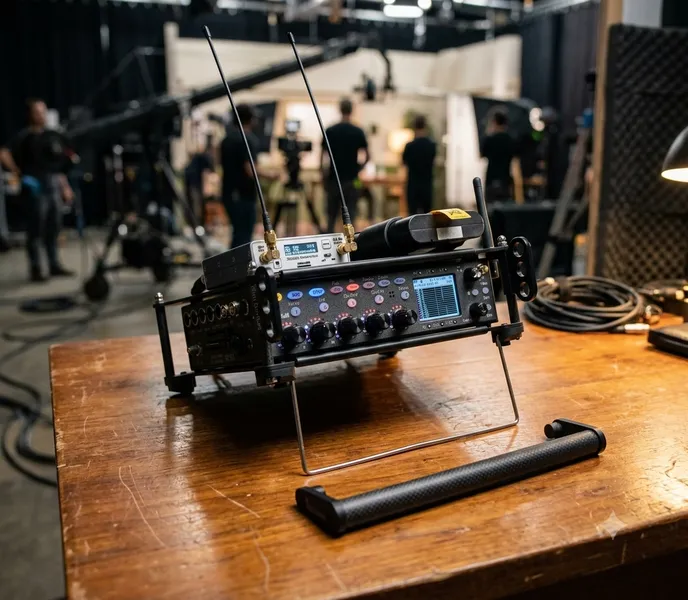
    Inside the Bag: Maximizing the Zaxcom Nova 2 and the VTX Board Upgrade

    For professional sound mixers, the relentless pursuit of reducing bag weight while expanding track counts and functionality is a balancing act. When Zaxcom dropped the original Nova, it redefined the "all-in-one" workflow by jamming a mixer, recorder, ZaxNet hub, and dual wireless receiver slots into a 3.5-pound footprint.

    The Zaxcom Nova 2 refines this formula, bringing expanded AES I/O (up to 16 digital inputs), robust processing, and those highly addictive infinity encoders. But for mixers looking to fully streamline their setup, the real conversation centers around the optional VTX internal transmitter board. (Trew Audio)

    Let’s dive into what makes the Nova 2 a production powerhouse, and whether checking the box for the optional VTX board is right for your workflow.

    The Nova 2 Foundation: What We Love Before looking at the VTX expansion, it's worth noting why the Nova 2 remains a top-tier centerpiece for bag mixers:

    • NeverClip™ Preamps: Boasting 140 dB of dynamic range on its four primary XLR inputs, it handles unexpected shouting or transient explosions flawlessly without needing brick-wall limiters. (Gotham Sound)

    • The Unmatched Slot-In Advantage: Dual slots accommodate MRX414 modules, allowing you to pull in up to 8 channels of digital wireless internally. No external audio loops, no power distribution nests, and significantly less RF loss. (Dale Pro Audio)

    • MARF II Recording: Zaxcom’s proprietary Mobile Audio Recording Format writes directly and instantly to the primary CF card. If your battery drops mid-take, your file isn't corrupted. (Trew Audio)

    Enter the VTX Board: The Ultimate Bag Consolidation? The Nova 2 is sold in two primary configurations: standard (relying on its built-in 2.4 GHz ZaxNet transmitter) and the Nova 2-V, which includes the integrated VTX VHF transmitter module.

    The VTX board is explicitly designed to transmit high-quality analog/digital IFB audio and timecode to client monitoring systems—specifically tailored to work alongside Zaxcom's VRX1 VHF receivers, as well as legacy VHF systems.

    ZAXCOM NOVA 2
    Dual Receiver Slots Optional VTX Board
    (Up to 8 ch Wireless) (Internal VHF IFB/TC Transmit)

    The Virtues: Why Mixers Love the VTX Board

    1. Zero-Footprint IFB Transmission Without the VTX board, if you want a high-power VHF feed for clients or script supervisors (like running a Comtek or external transmitter), you have to mount an external TX to your bag, wire up an audio output, and run a separate power tap. The VTX board lives completely inside the chassis, powered internally, utilizing a dedicated SMA port on the box.

    2. Radical Power and Space Savings By eliminating an external transmitter, you shave precious ounces off your bag and clean up your cabling. Furthermore, because it’s engineered directly into the Nova 2's power rail, the power consumption is incredibly efficient compared to firing up a completely separate third-party transmitter.

    3. Deep ZaxNet Integration The VTX board seamlessly coexists with ZaxNet functionality. You get a centralized hub where scanning for clean frequencies automatically places your talent transmitters into non-transmitting mode, evaluates the local spectrum, and maps out clean channels instantly. (Gotham Sound)

    The Drawbacks: Points to Consider While the VTX board sounds like a no-brainer, there are real-world trade-offs that sound mixers should weigh carefully.

    1. Ecosystem Lock-In To get the absolute most out of the VTX board’s specialized capabilities, you really want to be pairing it with Zaxcom's dedicated VHF equipment (like the VRX1). While mixers report great results jumping onto legacy analog VHF channels (like Comtek frequencies), your mileage may vary if your local client base or rental houses are firmly married to a different monitoring ecosystem.

    2. Concentration of Assets (The Single Point of Failure) When your mixer, recorder, receivers, ZaxNet hub, and IFB transmitter are all inside one single chassis, your entire sound department lives in one basket. If the unit ever needs to go back to the factory for service or a hardware repair, you aren't just losing your recorder—you are losing your entire wireless and client-monitoring infrastructure.

    3. Field Serviceability vs. Factory Upgrades The Nova 2 is vastly improved in terms of field serviceability (the memory card interface and standard IFB antennas are modular). However, if you buy the base Nova 2 model and decide you want the VTX board down the line, it requires sending the machine back for a factory upgrade, rather than being a simple user-swappable drop-in slot. (Trew Audio)

    The Verdict If you are a location sound mixer who thrives on a lightweight "run-and-gun" reality bag, a commercial setup, or fast-moving indie features, the Nova 2 with the VTX board is arguably the neatest audio package available. It completely removes the "bag acne" of Velcroed transmitters and cable nests.

    However, if your workflow requires throwing an IFB transmitter high up on a master antenna mast away from your body, or if you regularly interface with crews providing their own non-VHF monitoring setups, sticking with the base Nova 2 and utilizing external AES/analog routing might give you the modular flexibility you need.

    Are you considering updating your current bag architecture to an all-in-one system, or are you looking to integrate the Nova 2 into an existing cart-based workflow?

  • Posted on
    Deity PR-4 vs. Sound Devices MixPre-3 II

    Battle of the Ultralights: Deity PR-4 vs. Sound Devices MixPre-3 II

    For years, if you wanted professional, "never-clip" 32-bit float audio in a compact package, the industry answer was automatic: get a Sound Devices MixPre-3 II. It’s been the gold standard for run-and-gun filmmakers, podcasters, and sound designers alike.

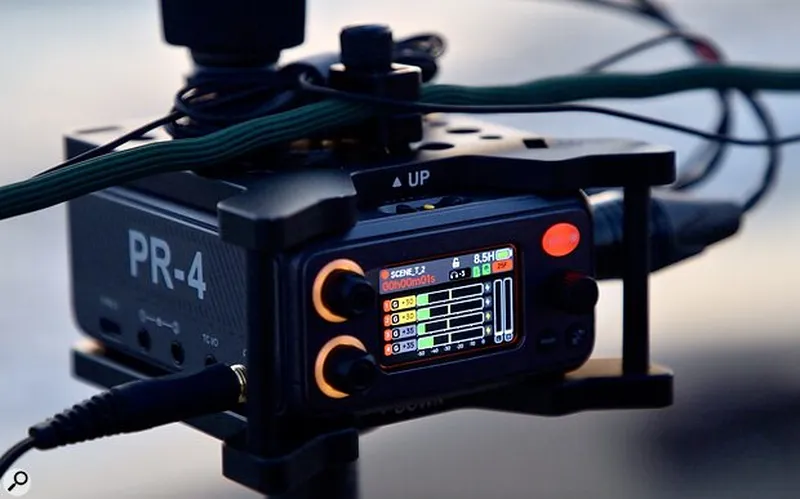
    But Deity has shaken things up with the PR-4, a six-track field recorder specifically built to challenge that undisputed crown

    If you’re trying to decide between the classic titan and the new challenger, the choice actually comes down to your physical rigging and your wireless workflow. Here is how they stack up.

    The Quick Verdict: Which Should You Buy?


    Choose the Deity PR-4 if: You run a solo or small-crew video rig, use wireless lavaliers alongside a boom, rely on app-based control, and want an all-in-one wireless timecode ecosystem without buying extra hardware boxes.

    Choose the Sound Devices MixPre-3 II if: You require the absolute lowest noise floor for whisper-quiet environments (like nature recording), want full-sized physical gain knobs, and need three dedicated XLR inputs rather than combo/3.5mm compromises.


    The Tail of the Tape: Spec Comparison

    Feature Deity PR-4 Sound Devices MixPre-3 II
    Max Tracks 6 tracks (4 ISOs + Stereo Mix) 5 tracks (3 ISOs + Stereo Mix)
    Physical Inputs 2x XLR/TRS Combo, 1x Stereo 3.5mm 3x XLR
    Preamps / Gain ReGain Preamps (+60 dB) Kashmir Preamps (+76 dB)
    Max Resolution 32-bit Float / 192 kHz 32-bit Float / 192 kHz
    Storage Backup Dual: SD Card + Internal 64GB SSD Single: SD Card only
    Remote Control Sidus Audio App (Bluetooth) Wingman App (Bluetooth)
    Timecode Wired I/O + Native Wireless Sync Wired I/O (BNC / Aux In)
    Power Options Sony NP-F550, USB-C PD, 4-pin Hirose AA sled, Sony L-Mount sled, USB-C
    Price ~$449 ~$895

    3 Critical Differences You Need to Know

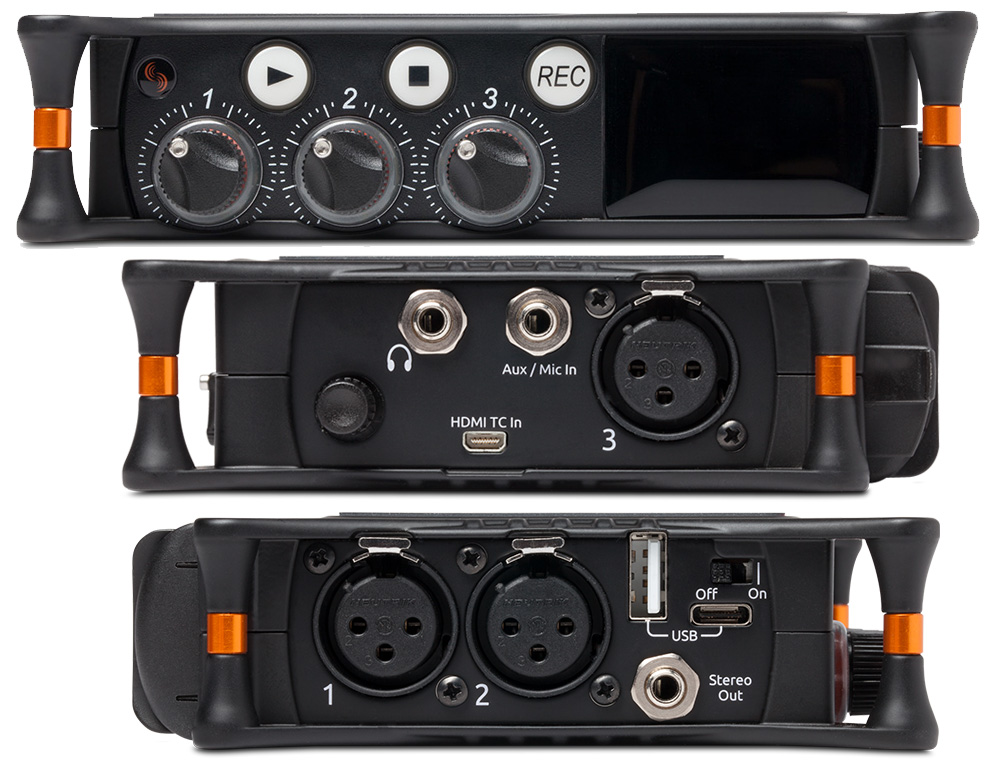
    1. The Inputs: 3 XLRs vs. "The Hybrid 4" The MixPre-3 II features three pristine, full-sized XLR inputs powered by legendary Kashmir preamps. They offer an incredible +76 dB of gain, making them capable of driving notoriously "gain-hungry" dynamic mics (like the Shure SM7B) completely clean.

    The Deity PR-4 offers four inputs, but they are split up: two XLR/TRS combo jacks and a stereo 3.5mm jack for channels 3 and 4 (B&H)

    • Why this matters: If you're hosting a 3-person podcast with XLR mics, the MixPre wins. But if you’re a videographer running a boom mic on XLR and a dual-channel wireless receiver (like a DJI Mic 2 or Rode Wireless PRO) via 3.5mm, the PR-4 gives you four clean tracks without needing messy adapters. (CVP)

    2. Timecode & The Wireless Ecosystem Both recorders handle standard wired timecode perfectly. However, the Deity PR-4 pulls ahead for solo shooters by acting as a wireless timecode master hub. Out of the box, it can natively sync timecode over the air to Deity's TC-1 boxes or TC-SL1 smart slates. If your cameras are outfitted with Deity gear, syncing your entire set takes seconds from the Sidus Audio phone app. To get wireless timecode on the MixPre, you have to buy a third-party add-on like a Timecode Systems Bluetooth module. (Sound on Sound)

    3. Redundancy: The "Forgot My SD Card" Lifesaver If you’ve ever formatted a card on set by accident, this feature will resonate with you. The MixPre-3 II records strictly to a single SD card. The Deity PR-4 introduces dual-media recording: it writes your tracks to an SD card and a built-in 64GB internal SSD simultaneously. If your card fails, or if you simply leave it sitting in your computer's card reader at home, the PR-4 still saves your shoot. (Deity Microphones)

    The Usability Factor The MixPre-3 II features beautiful, tactile physical knobs on the front for dialing in your headphone levels or mixes on the fly. The PR-4 relies heavily on its AMOLED touchscreen interface and smartphone app. If you hate digging through digital menus in the field, the MixPre's analog layout remains unmatched.

    Summary The Sound Devices MixPre-3 II remains an absolute boutique audio powerhouse with unmatched preamps, stellar build quality, and a premium price tag to match.

    However, at roughly half the price, the Deity PR-4 isn't trying to beat Sound Devices at the acoustic engineering game—it's trying to out-smart it. By packaging an internal SSD backup, 4-input camera-bag friendly routing, and built-in wireless timecode into a tiny footprint, it's easily the more practical tool for the modern independent videographer.

    Which of these features matters most to your setup—preamp power or built-in backup?

  • Posted on
    The Giant Killer?

    The Giant Killer? Why the Deity PR-4 is a Game-Changer for Run-and-Gun Audio

    If you’ve ever shot a documentary, a wedding, or a multi-person interview on a tight budget, you know the absolute panic of managing audio. You’re trying to balance gain staging so your subjects don't clip, praying your single SD card doesn't corrupt, and desperately trying to keep your camera and timecode boxes synced.

    Until now, fixing those headaches meant buying a massive, expensive field recorder and dedicating an entire bag to it.

    Enter the Deity PR-4. Launched at NAB 2026 (where it scooped up multiple Product of the Year awards), this tiny powerhouse isn't just another generic audio recorder. It’s a beautifully thought-out, pocket-sized 4-input / 6-track field recorder designed to bring high-end production features down to an indie price point ($449)

    Here is everything you need to know about why this little box is a massive deal for solo operators and small crews.

    1. Zero Risk of Clipping: 32-Bit Float & ReGain Preamps™

    The headline feature for most creators will be the 32-bit float recording. If you aren't familiar, 32-bit float essentially eliminates the need for setting input gain. Whether your subject is whispering or screaming into the microphone, the dynamic range captured is so wide that you can simply adjust the volume in post-production without adding noise or clipping the audio. (Trew Audio)

    But Deity took it a step further by pairing this architecture with their brand-new ReGain Preamps™. Boasting an exceptionally low noise floor (-127 dBV EIN) and up to +60 dB of ultra-clean gain, these preamps can drive notoriously power-hungry dynamic microphones (like a Shure SM7B or a heavy-duty shotgun mic) beautifully without needing external inline boosters like a Cloudlifter. (Deity Microphones)

    2. The Ultimate Safety Net: True Dual Media

    Ask any professional shooter what their biggest nightmare is, and they’ll tell you: a corrupted SD card at the end of a 12-hour shoot.

    Usually, to get simultaneous backup recording, you have to spend thousands of dollars on enterprise-tier mixers. The PR-4 completely flips the script. It records your audio simultaneously to an external SD card (up to 1TB) and a built-in, shock-resistant 64GB internal SSD.

    If your SD card glitches, gets lost, or accidentally formatted, your entire shoot is still sitting perfectly intact inside the hardware. This feature alone makes the $449 price tag worth every penny. (Videomaker.com)

    3. Pocket-Sized I/O and Native Wireless Timecode

    Don't let its size fool you. The PR-4 gives you plenty of routing flexibility:


    Inputs: 2x XLR/TRS combo jacks (supporting analog balanced signals or up to 4 channels of digital AES3/AES42) plus a stereo 3.5mm TRS jack for channels 3 and 4 (perfect for hooking up dual wireless lavalier receivers). (B&H)

    Outputs: Two stereo 3.5mm outputs alongside a dedicated headphone jack, letting you route custom mixes directly into your cameras or monitoring setups. (Sound on Sound)


    The real magic? The timecode. The PR-4 acts as a master timecode generator for your entire set. It can jam-sync cameras via a standard 3.5mm wired connection, but it is also the world's first recorder to natively sync wirelessly to Deity’s ecosystem of TC-1 boxes and smart slates directly through the hardware and the Sidus Audio app.

    Technical Specifications at a Glance

    Feature Specification
    Tracks / Inputs 6 Tracks total (4 physical inputs)
    Bit-Depth / Resolution 24-bit, 32-bit, and 32-bit Float up to 192 kHz
    Preamps ReGain Preamps™ (+60 dB Clean Gain, -127 dBV EIN)
    Storage Architecture Dual Media: 1x SD Slot (up to 1TB) + 64GB Internal SSD
    Smart Tech VoiceAware Automix, Sidus Audio App remote control

    Smart Design for Real Workflows

    Deity didn't just design this in a lab; they built it for the field. Instead of burning through AA batteries every few hours, the PR-4 runs on a single NP-F550 rechargeable battery, netting you upwards of 8 to 10 hours of runtime. It can also be powered or recharged directly over USB-C. (Adorama)

    They also fixed the classic "spinning accessory" problem. The top and bottom features dual ARRI-style 1/4"-20 mounts with anti-rotation locating pins. When you screw this onto a camera cage or an arm, it locks down completely solid. If you want to build it out further, Deity offers a dedicated metal cage ($59) featuring a built-in ORTF layout template to quickly mount a perfectly configured stereo pair of microphones.

    The Verdict

    The Deity PR-4 bridges the gap between ultra-compact "creator" gear and elite broadcast equipment. It takes the stress out of gain staging, guarantees a physical backup of your data, fixes your timecode sync issues, and fits right into a lightweight camera rig or an incredibly small audio bag.

    For solo videographers, documentarians, and independent filmmakers, the game just changed.

  • Posted on
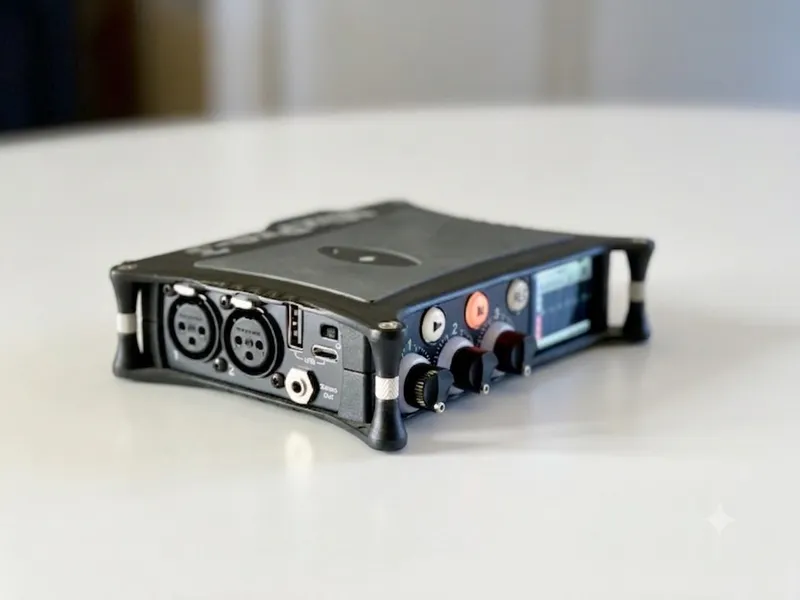
    Unleash Perfect Sound with the MixPre-3 II

    Unleash Perfect Sound: Why the Sound Devices MixPre-3 II is a Game-Changer for Creators

    For podcasters, filmmakers, and field recordists, pristine audio isn't a luxury—it's a necessity. Enter the Sound Devices MixPre-3 II, a compact marvel that packs professional, broadcast-quality recording into a device small enough to fit in your bag. This isn't just an incremental update; it’s a powerful tool designed to eliminate common recording headaches and let you focus on your craft.

    The Magic of 32-Bit Float: Say Goodbye to Clipping

    The headline feature of the MixPre-3 II is its support for 32-bit float recording. This isn't just a bigger number; it’s a fundamental change that offers a virtually limitless dynamic range.

    What does that mean for you?

    • No More Clipping (Practically): Imagine recording a quiet interview followed by a sudden, ear-splitting clap of thunder. In 24-bit, you'd likely clip the thunder. With 32-bit float, you capture all the detail, and you can recover the "clipped" audio in post-production with zero loss of quality or added noise.

    • Set It and Forget It: This technology allows you to set your levels to a safe, general range and stop worrying about sudden peaks. It dramatically simplifies the recording process, especially for solo operators or in unpredictable environments.

    World-Class Preamps: The Kashmir Advantage

    Professional audio starts at the preamplifier, and the MixPre-3 II is equipped with Sound Devices' acclaimed Kashmir mic preamps.

    • Ultra-Low Noise: With a stunning -130 dBV noise floor and a massive 76 dB of clean gain, these preamps can drive even the most gain-hungry microphones (like the Shure SM7B) without needing an external booster.

    • Pristine Quality: They deliver a clean, transparent, "silky smooth" tone that rivals recorders many times its size and price, giving your audio a professional sheen right from the source.

    Versatility in a Compact Form

    The MixPre-3 II is much more than just a recorder; it's a full production hub that adapts to any scenario:

    • Inputs: It features three high-quality XLR inputs for microphones, plus a 3.5mm Aux/Mic input, allowing you to capture up to five tracks (3 ISOs + a stereo mix) simultaneously to an SD card.

    • USB Audio Interface: Connect it to your Mac or PC via USB-C, and it instantly transforms into a 5-in/2-out USB audio interface—perfect for high-quality podcasting, streaming, or home studio work.

    • Timecode Integration: Essential for videographers, the MixPre-3 II features an internal LTC timecode generator and can receive triggers from cameras via HDMI, ensuring your audio and video are perfectly synced.

    • Durable and Portable: Housed in a die-cast aluminum chassis, this recorder is built to withstand the rigors of field recording while remaining remarkably lightweight.

    Who Should Buy the MixPre-3 II?

    • The Solo Filmmaker/Videographer: You need top-tier audio but can't constantly monitor levels while operating a camera. 32-bit float is your safety net.

    • The Serious Podcaster: You demand the best sound quality for your multi-mic recordings and need an interface that can power your studio-grade microphones.

    The Field Recordist: You capture everything from quiet nature sounds to loud cityscapes and need the dynamic range and low-noise performance of the Kashmir preamps.

    Final Take

    The Sound Devices MixPre-3 II is an investment in flawless audio. It removes the technical anxiety of setting levels and delivers a sound quality that will immediately elevate your productions. If you're ready to make audio problems a thing of the past and hear the true potential of your microphones, the MixPre-3 II should be at the top of your gear list.

  • Posted on
    Sound Devices 788T: The Field Recorder That Defined an Era

    Enhanced by the CL-8 and CL-9

    The Sound Devices 788T digital audio recorder, though a legacy product, remains legendary in the world of professional production sound. Its combination of portability, robust build quality, and extensive feature set made it a staple for sound mixers on film, TV, and documentary sets. Paired with its dedicated control surfaces—the CL-8 and CL-9—the 788T transformed from a powerful recorder into a comprehensive, highly flexible mixing and recording system.


    The 788T: A Compact Powerhouse 💪

    The 788T was designed for demanding field applications, offering superb audio quality and reliable performance in a compact form factor. Key 788T Features:

    • 8 Pristine Inputs & 12-Track Recording: It boasts eight full-featured, ultra-low-noise microphone preamplifiers that accept mic or line-level signals. It can record up to 12 tracks simultaneously, allowing for isolated tracks ("isos") for each input plus a stereo mix and two auxiliary tracks.

    • Time Code and Synchronization: A high-accuracy, on-board time code generator/reader (supporting all standard frame rates) and word clock I/O ensure seamless synchronization with cameras and other production equipment—critical for sound-for-picture work.

    • Durable Storage: The recorder utilized multiple recording media options, including an internal hard drive (or later, an SSD), a CompactFlash (CF) card, and external FireWire drives, all of which could be used simultaneously for immediate backups.

    • Built-in Processing: Each input included essential tools like 48V phantom power, fully adjustable high-pass filters, and robust peak limiters.

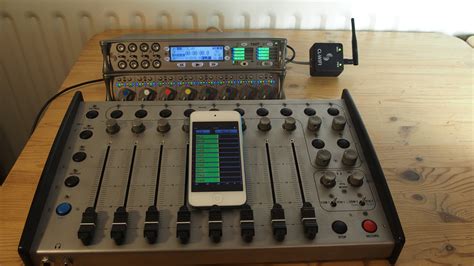
    • Taking Control: The CL-8 and CL-9While the 788T is fully functional on its own, its compact size means menu diving is sometimes necessary. This is where the CL-8 and CL-9 control surfaces stepped in, vastly improving the user experience for on-set mixing. Both connected to and were bus-powered by the 788T via a single USB cable.


    The CL-8: Rotary Control for the Bag Mixer: The CL-8 was designed as a lightweight, portable mixing surface for the sound mixer working "over-the-shoulder" or from a compact audio bag.

    • Rotary Faders: It features eight large, tactile rotary faders (knobs) to control the input-to-mix levels (L/R and Aux tracks).

    • Quick Access Buttons: Dedicated push buttons provide immediate, visual control over critical channel functions like High-Pass Filter, Limiter, Polarity Reverse, Mute, and Solo for each of the eight inputs.

    • Simple and Durable: The design is focused on durability and simplicity, providing essential mixer-type controls without adding excessive bulk or weight.


    The CL-9: Linear Precision for the Sound Cart

    • The CL-9 is the larger, more advanced mixing surface, perfect for sound mixers working on a stationary sound cart where precision and more controls are desired. It effectively turns the 788T into a professional mixing console.

    • Eight 100mm ultra-low-latency linear faders for highly precise and smooth level control.

    • Dedicated Rotary Trim controls for each input, plus a full sweepable, single-band parametric EQ per input (Frequency, Gain, and Q) added to the 788T's feature set.

    • Dedicated control over Input Pan and Output Level for all six analog outputs.Communication

    • Dedicated connections and controls for a slate circuit and private talkback circuits (Return Inputs) for seamless communication with the boom operator and talent.

    • Four additional user-programmable controls for assigning menu items to physical knobs.

    The System's Legacy The 788T and its controllers provided a generation of production sound mixers with a powerful, flexible, and robust recording solution. The ability to switch between the compact, rotary-fader CL-8 for mobile work and the comprehensive, linear-fader CL-9 for cart-based mixing made the 788T System incredibly versatile and a true industry standard for high-track-count, sync-sound recording that can now be purchased on the second-hand market for a fraction of its original price.

  • Posted on
    Why the Zoom F8n Was Never Ready for the Big Leagues

    Why are there so many of thest on eBay?

    The Zoom F8n (released in 2018 as an update to the original F8 from 2015) was a watershed moment in location audio. It was the first time an 8-input, timecode-accurate recorder was available for under $1,000, bringing "pro-sumer" features to the masses. Yet, for all its disruptive potential, the F8n was ultimately a temporary solution—a stepping stone that was outdated almost from the start and never truly met the demands of high-pressure, professional production.


    It’s time to be honest: while the F8n is an incredible value for the indie filmmaker or the hobbyist, relying on it for high-end work is a workflow risk that professionals shouldn't take.

    • The Pro-Level Features Were Compromised The F8n marketed itself on professional features, but many of them had caveats when compared to the industry standard Sound Devices and Zaxcom recorders:

    • Outputs: The Wrong Connectors. Professional gear lives in a world of balanced XLR connectors. The F8n offers two main outs on TA3 mini-XLR jacks, requiring adapters and introducing unnecessary points of failure. The sub-outs are an unbalanced 1/8” mini-jack, which is firmly a consumer-level choice for feeding cameras or other devices.

    • The Headphone Amp: A Notorious Weak Point. A major complaint across professional forums (even on the F8n Pro) is the poor quality and lack of clarity in the headphone output. For a professional sound mixer, the headphone amp is the single most critical monitoring tool. If you can't trust what you're hearing, you can't deliver a good mix.

    • Mixing Controls: A Muddled Workflow. While the optional F-Control offers physical faders, there's persistent confusion about the relationship between the physical Trim knobs and the Faders, with some users finding the faders primarily control the mix to the output tracks, not the recorded ISO track gain in real-time. This departure from standard broadcast console workflow adds friction and potential for error in a fast-paced environment.

    • The Limiter Isn't Analog This is perhaps the biggest philosophical divide between Zoom and the high-end competition. The F8n uses an Advanced Look-Ahead Hybrid Limiter that operates in the digital domain. While Zoom touts its efficiency and "look-ahead" capability, a digital limiter requires the incoming analog signal to be converted to digital before the limiter is applied.


    By contrast, recorders like those from Sound Devices apply analog limiters before the Analog-to-Digital (A/D) conversion. This is the ultimate safeguard against clipping on the loudest, most unexpected peaks, as it truly tames the signal before it's digitized. For the pro mixer who cannot tolerate a clipped track, this distinction is not academic; it is mission-critical. The digital limiter is a compromise based on the F8n's internal architecture, not a superior design choice.

    • The Onslaught of "Pro" Successors Confirms the Flaw The most telling sign that the F8n was incomplete is the speed with which Zoom felt compelled to release its successor, the F8n Pro (2022). The Pro model addressed the glaring gap of the F8n's dynamic range and gain management by incorporating 32-bit float recording.

    The F8n's original 24-bit/192 kHz recording was already considered professional quality, but 32-bit float fundamentally solves the problem of setting input gain correctly by making clipping practically impossible.

    The fact that a "Pro" version was quickly released with this game-changing feature suggests the original F8n (and to a lesser extent, the F8n itself) had a demonstrable deficiency when pushed to its limits by demanding, unpredictable production sound. Once 32-bit float became a feature on competitive recorders, the 24-bit F8n instantly became a legacy product in a competitive field.

    The Zoom F8n was revolutionary for its price point, but its compromises in monitoring, outputs, and gain-staging safety meant it was a stepping stone—a necessary tool for the budget-conscious, but ultimately never truly ready to be the workhorse on a major professional set.


    The video below shows a hands-on comparison between the original F8 and the Sound Devices 688, highlighting the feature gap that was present even at the beginning of the F-series line: Zoom F8 vs Sound Devices 688: Hands-On Sound Comparison.

  • Posted on
    Maximize Your Workflow: Why the Sound Devices 688 Remains a Field Audio Staple

    Is the Sound Devices 688: Still the King of the Sound Bag?

    For professional sound mixers, the equipment you carry isn't just a collection of gear—it's the heart of your operation. When Sound Devices introduced the 688 12-Input Field Production Mixer/Recorder, it quickly became a benchmark for versatility and reliability in the bag. Even with newer models on the market, the 688's blend of powerful features, robust design, and smart workflow integration makes it a timeless choice for complex productions.


    More Inputs, Smarter Mixing The 688 is a true powerhouse, built for demanding jobs. It offers a massive 12 analog inputs (six high-bandwidth mic/line inputs on XLR, plus six line-level inputs on TA3 connectors). This capacity, combined with its 16-track integrated recorder (recording Broadcast WAV files to both SD and CompactFlash cards), gives you the flexibility to handle everything from documentary interviews to high-track-count reality TV.

    But its true genius lies in its processing:

    • MixAssist™ Auto-Mixing: This is a game-changer for multi-mic setups. The 688's sophisticated algorithm automatically attenuates inactive mics, helping to maintain consistent background noise and reducing common phasing and comb filtering issues that plague complex dialogue scenes. It's an invaluable tool for on-the-fly mixing that still provides clean ISO tracks for post-production.

    • Flexible Routing: All 12 inputs can be routed pre- or post-fade to the eight output buses (L/R mix + Aux 1-6), allowing for simultaneous feeds to multiple cameras, client monitoring, and other external devices.

    Designed for the Field Sound Devices is known for building equipment that can take a beating, and the 688 is no exception. Its lightweight, durable chassis is packed with features designed for real-world production:

    • PowerSafe™ Technology: Never fear an accidental power loss again. This exclusive circuitry provides an integrated 10-second power reserve, allowing the unit to safely stop recording and properly close all files, protecting your valuable audio.

    • QuickBoot: The 688 powers on and is ready to record in less than two seconds, ensuring you never miss the action.

    • Ambient Timecode: It features a world-renowned Ambient timecode generator and reader, supporting all common rates and modes for rock-solid sync.

    • Bright Display: The 1000-nit LCD screen ensures excellent visibility, even in bright sunlight, making it easy to monitor your levels and navigate menus.

    • The SL-6 Integration For the ultimate cable-free bag setup, the 688 pairs seamlessly with the optional SL-6 Power Distribution and Wireless System.

    The SL-6 attaches to the 688 and:

    • Provides powering and audio interconnection for up to three dual-channel wireless receivers via the SuperSlot™ standard.

    • Distributes a single NP-1 battery supply to the 688 and all connected wireless receivers, significantly reducing battery and cabling clutter.

    • Enables integrated control and monitoring of SuperSlot-compatible receivers directly from the 688's screen.

    Final Takeaway The Sound Devices 688 is more than just a mixer or a recorder; it's a consolidated production audio solution. By integrating multi-channel mixing, auto-mixing, and multi-track recording with features like PowerSafe and optional wireless integration, it provides an unparalleled combination of performance, workflow efficiency, and peace of mind. For sound mixers tackling demanding field work, the 688 is a tool that elevates the entire production.