
- Posted on
- • Accessories
The Unsung Hero of the Gear Bag
- Author
-
-

- User
- Rusty Rogers
- Posts by this author
- Posts by this author
-
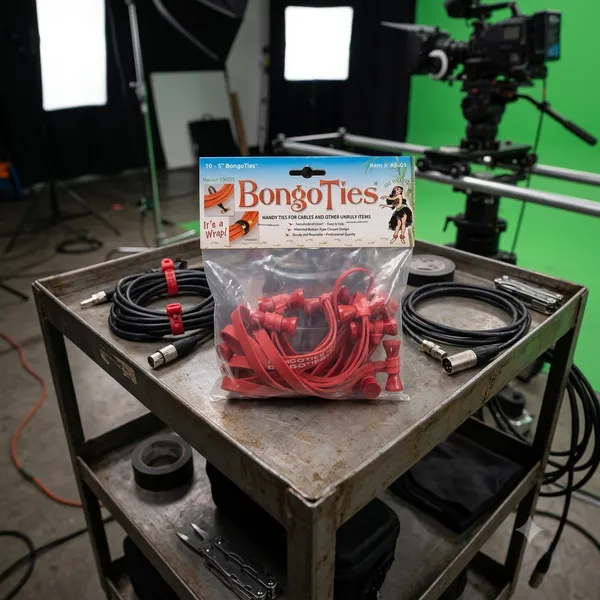
The Unsung Hero of the Gear Bag: Why You Need Bongo Ties
If you work in film, photography, music, or IT, you already know the nightmare: a tangled bird's nest of extension cords, HDMI leads, and audio cables sitting at the bottom of your bag.
While the world tries to sell us complex plastic clips and disposable zip ties, the film industry's best kept secret is beautifully simple, incredibly cheap and practically indestructible.
Meet the Bongo Tie
Brilliant design in its simplest form.
Invented by a pro photographer who was tired of wrestling with sticky tape and flimsy hook and loop straps, a bongo tie consists of just two elements
A heavy duty, highly durable, Hevea rubber band.
A patented flared bamboo pin that acts as a toggle.
There are no gears, no hooks, no plastic to snap in cold weather. You just wrap the rubber band around your cables, loop it over the bamboo flared ends, and it snaps, locked under its own tension.
4 reasons, they beat everything else.
- No sticky residue: Unlike gaffer tape or electrical tape, they leave zero residue on expensive cables.
- True one-handed operation: You can easily lock or release them with one hand while holding a heavy coil of wire with the other.
- Reusable for years: Zip ties are a single use plastic waste nightmare. Bongo ties can be used hundreds of times before the rubber finally loses its snap.
- The flared pin advantage: because the bamboo toggle is flared on both ends, the loop can't accidentally slide off, even under heavy vibration.
Beyond Cables: Through Creative Uses
While they were built for cords, anyone who owns a pack quickly discovers they are the ultimate "fix-it" tool. Production crews use them to strap wireless receivers to camera rigs, musicians use them to secure loose mic stands, and campers use them to lash gear to backpacks.
In a world full of over-engineered gadgets, the Bongo Tie is a refreshing reminder that sometimes, the simplest solution is the best one.