
- Posted on
- • Learning
Mastering Silence: A Professional Guide to Ground Loop Elimination in Audio Systems
- Author
-
-

- User
- Rusty Rogers
- Posts by this author
- Posts by this author
-
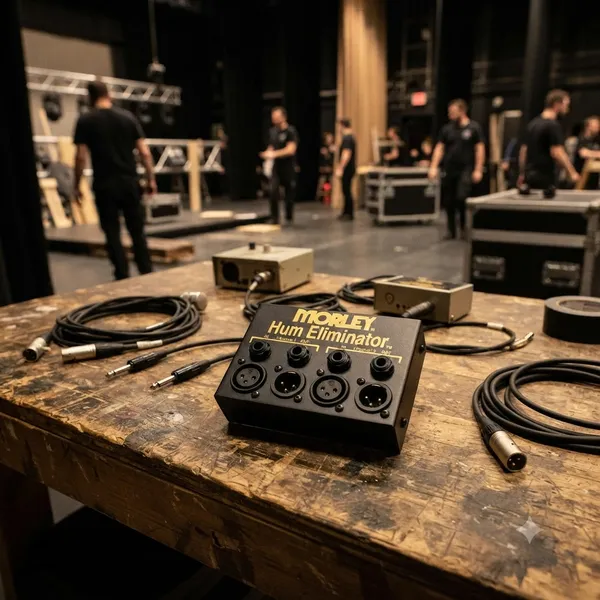
Mastering Silence: A Professional Guide to Ground Loop Elimination in Audio Systems
In professional audio environments, one of most persistent and frustrating issues is ground loop noise—a low-frequency hum or buzz caused by electrical potential differences between equipment connected via signal cables. This creates a closed circuit through the grounding systems of multiple devices, which can pick up electromagnetic interference (EMI) along its path. To ensure high-fidelity sound reproduction in studios or live venues, understanding how to manage these signals using Ground Loop Eliminators is essential for any engineer.
At A Glance: Signal Comparison
| Feature | Microphone Level Signals | Line-Level Signals |
|---|---|---|
| Primary Challenge | Low voltage makes them highly sensitive to noise floor interference | Large signal paths in racks increase the risk of multi-device loops |
Mitigating Microphone Level Issues
Microphones produce extremely low voltages, which makes them inherently susceptible to any noise introduced into their signal chain. If a microphone is connected via an unbalanced cable and there is a potential difference between its power source and the mixer's ground, hum will be immediately audible in the mix.
- Balanced Connection: A technique utilizing two conductors carrying identical signals with opposite polarity to cancel out induced interference at the receiver.
- Ground Lift Switch: A physical toggle on professional DI boxes that breaks connection of pin 1 between inputs and outputs, effectively severing a potential ground loop without interrupting audio flow.
Managing Line Level Signals in Complex Chains
As signals progress through more hardware—such as compressors or equalizers—they enter the line-level stage where they are significantly stronger but still susceptible to loops within complex signal paths. In many professional setups, different racks might be on separate power circuits, creating significant potential differences that a standard DI box may not solve if used incorrectly at lower levels of the chain.
To address this in high-impedance or long-distance routing scenarios: - Isolation Transformer: Use an isolation transformer to provide galvanic isolation between two pieces of gear while maintaining signal integrity via magnetic induction rather than direct electrical contact. - Dedicated Line Level Isolator: Employ a dedicated line level isolator when connecting multi-channel consoles to external processing hardware that might otherwise introduce noise into the mix through shared grounding paths.
Active vs Passive DI Boxes: Choosing Your Defense
To effectively manage these issues, selecting the correct type of Direct Injection (DI) box is crucial for signal isolation and maintaining a low noise floor. While both types are used to convert unbalanced signals to balanced ones, their approach to ground loops differs based on how they handle electrical connectivity.
- Passive DI Box: These devices utilize an internal transformer rather than electronic circuitry to transfer the audio signal via magnetic induction. Because there is no direct physical wire connecting the input and output terminals through a component like a transistor or resistor, passive DIs provide true galvanic isolation, making them highly effective at breaking ground loops entirely.
- Active DI Box: These units use active components (such as transistors) to boost low-level microphone signals before converting them to line level. While they offer excellent signal integrity and high input impedance for weak sources, their reliance on electrical circuitry means that the connection between stages is more direct; however, most professional models still include a Ground Lift switch to mitigate loop issues by breaking specific paths in the circuit.
Troubleshooting: Identifying Your Noise Source
Distinguishing between different types of interference can save significant time during setup and troubleshooting. Use these descriptors to identify your culprit:
- Ground Loop Hum: This is characterized as a constant, low-frequency (50Hz or 60Hz) steady drone that matches the frequency of local mains power. It often changes in volume if you move equipment between different outlets or add more gear to an existing circuit.
- EMI (Electromagnetic Interference): This typically manifests as a "buzzing" sound at higher frequencies than a ground loop hum, which can be erratic and caused by proximity to non-audio electronics like fluorescent lights, dimmers, or unshielded motors/fans.
- RFI (Radio Frequency Interference): You will hear this as high-pitched whistles, chirps, static, or "digital" buzzing sounds. It is often triggered when nearby mobile phones receive notifications or from the proximity of Wi-Fi routers and cellular towers via antenna effects on signal lines.