
- Posted on
- • Accessories
The Definitive Guide to Dugan Auto Mix on Sound Devices Mixers
- Author
-
-

- User
- Rusty Rogers
- Posts by this author
- Posts by this author
-
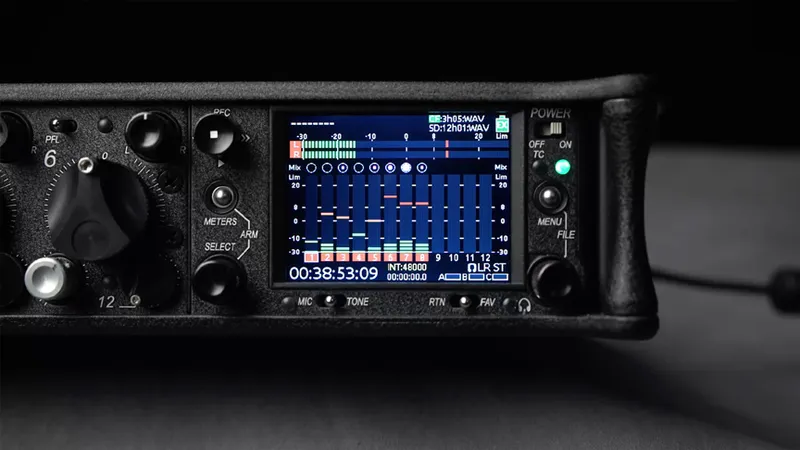
The Definitive Guide to Dugan Auto Mix on Sound Devices Mixers
In the world of professional audio, few challenges are as persistent as managing multiple microphones while maintaining clean, intelligible speech and preventing feedback. Enter the Dugan Auto Mix feature—a groundbreaking technology that has been revolutionizing live sound reinforcement for over 50 years. This comprehensive guide explores everything you need to know about Dugan Automix, how it works, its implementation on Sound Devices mixers, and the pros and cons of this remarkable system.
What is an Automatic Mixer?
The term "automatic mixer" can be somewhat misleading. An automatic mixer doesn't automate the entire mixing process—rather, it performs one critical task exceptionally well: continuously attenuating (turning down) microphones that aren't actively being used [1]. This simple yet elegant operation delivers two major benefits. First, it significantly reduces background noise in the mix, making desired speech cleaner and more intelligible [1]. Second, when used with a public address system, it allows for more gain before feedback occurs [1].
It's important to understand that automatic mixing is fundamentally different from limiting, compressing, or automatic gain control (AGC). While automatic mixers may incorporate these functions, their primary purpose is controlling multiple microphones so that system gain is directed where it's needed [2].
The History: From Dan Dugan's Theater to Professional Audio
Dan Dugan's journey into automatic mixing began in the 1960s when he worked as a sound designer in theater. After experimenting with several unsuccessful methods, he invented his groundbreaking approach to automatic mixing, receiving a patent in 1976 [1]. By 1971, Dugan had already begun manufacturing his Model A mixer, building 60 units before licensing his patents to Altec Lansing Corporation [2].
Altec produced a series of automatic mixers (the 1628, 1674, and their improved variants), but these were primarily designed for "installed sound"—equipment sitting unattended in church or courtroom closets [2]. It wasn't until 1993, when Dugan's Speech System patent expired, that he was free to bring his technology out of the closet and into professional live audio mixing [2]. In 1997, Dugan licensed Protech Audio to produce automatic mixers for the installed sound market and designed the Protech 2000 [2].
Today, Dugan Automix represents over five decades of refinement and patent-protected innovation.
The Mathematical Principle Behind Dugan's System
The core concept of the Dugan Speech System is both elegant and mathematically brilliant. Each individual input channel is attenuated by an amount in decibels equal to the difference between that channel's level and the sum of all channel levels [1]. The gain of all channels is adjusted immediately and continuously based on what each channel is receiving [1].
The genius of this mathematical construct is that the total gain through the system never changes—it always stays at 0dB [1]. This means that as each signal adds as an uncorrelated source (calculated using the root of the sum of squares), the system maintains perfect balance [1].
Real-World Examples:
All talkers at the same level (or no talking): - All microphones receive -6.02 dB attenuation [1]
Two talkers at 20 dB above other mics: - Active microphones receive -3.05 dB attenuation - Inactive microphones receive -23.05 dB attenuation [1]
A mix of incoming levels: - Each microphone's gain adjusts proportionally to its signal strength relative to the total [1]
In all cases, the total system gain adds up to exactly 0dB [1].
Sound Devices Implementation: Dugan Automix vs. MixAssist
Sound Devices mixers—including the Scorpio, 888, 833, 633, and 688—offer two automatic mixing algorithms: Sound Devices' proprietary MixAssist and Dugan Automix [1]. Understanding the differences between these two systems is crucial for choosing the right tool for your application.
Dugan Automix on Sound Devices
Dugan Automix operates on Dan Dugan's patented principle, providing continuous, smooth gain adjustments across all microphones. The algorithm runs post-fader, meaning users retain full control over microphone gain via the mixer's faders [1]. If a fader is turned all the way down, the microphone is effectively removed from the automatic mixer's operation [1].
The system achieves near-instantaneous microphone activation in approximately 2 milliseconds [1]. What makes Dugan Automix particularly distinctive is that microphones are neither completely on nor completely off—each is continuously mixed in various proportions, creating smooth gain transitions [1].
MixAssist: A Different Approach
Developed by Steve Julstrom while working for Shure, MixAssist represents an alternative philosophy for automatic mixing [1]. Compared to Dugan, MixAssist operates more like a sophisticated gate, making decisions to turn microphones on or off, albeit with very smooth transitions and finite off-attenuation [1].
MixAssist features several advanced technologies:
Noise-Adaptive Threshold (NAT): An ever-changing, automatically calculated threshold for each microphone [1]. This threshold uses a slow-attack and very fast decay characteristic, functioning as a "hole detector" that identifies room noise at the trough of the audio envelope [1]. Only varying speech-like signals (not steady-state sounds like air conditioning) will activate a microphone [1].
Maxbus: The envelopes of all microphone signals are logically combined to determine the instantaneous peak of the loudest microphone [1]. Each microphone's envelope is continuously compared to this Maxbus, and if the envelope exceeds it (while meeting NAT criteria), the microphone gates on [1]. Crucially, if a talker speaks into two or more microphones, MixAssist will only activate one, eliminating comb filtering [1].
Last Mic Lock-On: The last-used microphone remains active, creating seamless transitions [1].
Off-Attenuation: When a microphone turns off, it's attenuated by a certain amount—typically 15 dB—rather than being completely muted [1]. This results in more transparent sound, as there's little noise benefit to completely turning a microphone off [1].
Number of Open Mic Attenuator (NOMA): For each doubling of open microphones, gain is attenuated by 3 dB, maintaining total system gain at 0 dB [1].
Comparing Dugan and MixAssist
Both algorithms accomplish similar goals: attenuating inactive microphones and maintaining overall system gain at 0 dB [1]. Each offers near-instantaneous (~2ms) microphone activation [1].
However, subtle differences exist: - Dugan Automix is described by some as sounding smoother in operation, with all microphone gains continuously and smoothly changing [1]. - MixAssist is said to offer a lower noise floor, as microphones picking up constant noise are attenuated at all times [1].
Sound Devices encourages users to experiment with both algorithms to hear the subtle differences [1].
Features and Drawbacks
Benefits of Dugan Auto Mix
Reduced Background Noise: By continuously attenuating inactive microphones, Dugan Auto Mix significantly lowers the noise floor, delivering cleaner audio [1].
Increased Gain Before Feedback: The automatic attenuation prevents multiple microphones from creating feedback loops, allowing for higher system gain [1].
Natural Sound: Unlike gates that can produce choppy audio, Dugan's system adjusts gain proportionally, maintaining the natural ambience of the room [2].
Zero Threshold Management: Dugan's system requires no thresholds or other adjustments to set—it's totally automatic [1].
Operator Freedom: By handling microphone cueing automatically, the system frees operators to focus on quality and other tasks [2].
Versatile Applications: Dugan Auto Mix serves a wide range of applications, from broadcast news panels and television talk shows to conference sound reinforcement, dialogue recording for film and television, wireless microphones on stage, houses of worship, boardrooms, teleconferencing, and distance learning [2].
Drawbacks and Considerations
Post-Fader Operation: Since automatic mixing operates post-fader, manual fader adjustments can override the system's automatic gain management [1].
Algorithmic Differences: While both Dugan and MixAssist achieve similar goals, they sound different. Users must choose which algorithm best suits their application [1].
Learning Curve: Understanding the mathematical principles and operational characteristics requires time and practice [2].
No True "Mixing": The system doesn't perform actual mixing—the user still maintains full control of microphone gain via faders [1].
Integration Requirements: External Dugan units (such as the E-1A, E-2A, E-3A, Model M, Model N, and expansion cards like Dugan-MY16 for Yamaha and Dugan-VN16 for Avid) must be properly patched into mixer insert points or expansion slots [2].
Current Sound Devices Mixers with Dugan Automix
Sound Devices currently offers Dugan Automix on the following mixer models: - Scorpio - 888 - 833 - 633 - 688
All of these mixers also include MixAssist, providing users with the flexibility to choose between the two automatic mixing algorithms based on their specific needs [1].
External Dugan Products (For Non-Sound Devices Applications)
While not part of Sound Devices mixers, it's worth noting that Dugan offers a comprehensive range of automatic mixing controllers for various applications: - Model E-1A: Unbalanced analog with ADAT digital I/O support for 16 channels [2] - Model E-2A: Balanced analog I/O with 12 channels analog plus 16 ADAT channels [2] - Model E-3A: AES digital I/O at 48 or 96 kHz [2] - Model M: MADI connectivity with 32 channels at 96 kHz or 64 at 48 kHz [2] - Model N: Dante network connectivity with similar capacity to the Model M [2] - Model K: Physical keyboard remote controller for networked Dugan automixers [2] - Dugan-MY16: Expansion card for Yamaha digital mixers (16 channels at 44.1/48 kHz or 8 channels at 88.1/96 kHz) [2] - Dugan-VN16: Expansion card for Avid Live Mixers (16 channels standard, or 8 channels automix plus 8 ADAT I/O) [2] - Waves Dugan Automixer: Software plug-in for Waves MultiRack and SuperRack with 64 channels [2]
These units patch into input insert points (send and return loops) of mixing consoles, providing operators with full console features like EQ and sends alongside Dugan automatic mixing [2].
Conclusion
The Dugan Auto Mix feature represents a masterclass in audio engineering—simple in concept, brilliant in execution, and indispensable in multi-microphone applications. Whether you're recording dialogue for film, broadcasting a debate, or reinforcing sound in a house of worship, Dugan's patented system continues to deliver clean, intelligible audio while freeing operators from the endless chore of manually managing microphone faders.
Sound Devices' implementation of both Dugan Automix and MixAssist provides users with unparalleled flexibility, allowing them to choose the algorithm that best fits their sonic preferences and application requirements. As productions continue to use more microphones simultaneously, automatic mixing technology like Dugan's becomes not just a convenience, but an absolute necessity for professional audio excellence.
References: